You cast the perfect actor.
The performance is powerful.
The footage is beautiful.
But here’s the question most indie filmmakers don’t ask soon enough:
Do you actually own that performance?
If the actor didn’t sign a proper performer agreement, the answer may be no — and that single oversight can derail festivals, distribution, and sales years later.
This isn’t just about paperwork. It’s about whether you can legally finish, show, and sell your film.
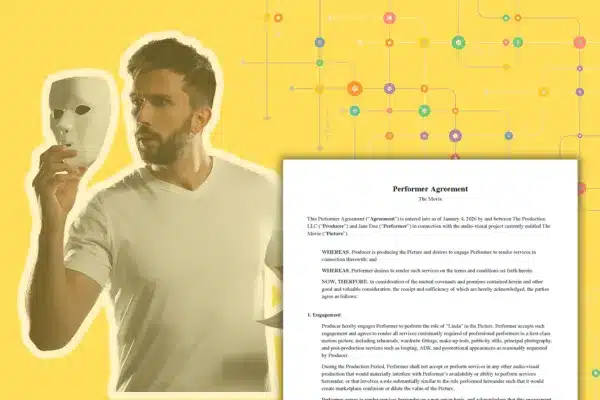
What Is a Performer Agreement in Film?
A Performer Agreement (sometimes called an actor agreement or talent contract) is the legal document that governs the relationship between a performer and a production. More importantly, it is the document that transfers the legal right to use the actor’s performance to the production entity.
A real performer agreement does far more than grant permission to appear on camera. It defines the scope of the performance, how it can be used, how the performer is compensated (or not), how they are credited, and what obligations continue after filming wraps.
Most critically, it contains chain-of-title language that distributors and E&O insurers rely on to confirm that the production owns what it claims to own.
Without that language, the footage may look great — but legally, it’s vulnerable.

Why a Talent Release Form Isn’t Enough
Many filmmakers rely on simple release forms because they’re fast, familiar, and easy to download. Releases can be appropriate in limited situations — documentaries, background appearances, b-roll, or unscripted environments.
But once an actor is performing scripted material, portraying a character, or contributing creatively to the story, a release form stops being enough.
A one-page release usually does not address compensation, deferred pay, backend participation, ADR or pickups, exclusivity, union status, or future distribution. It also rarely contains the ownership language required to clearly vest rights in the production company.
If the performer later disputes how their work is used — or asks to be removed — a release form often offers little protection.
Performer Agreement vs. SAG Contract vs. Talent Release
Not all productions need the same paperwork, and confusion here is common.
A talent release is generally limited to permission to use someone’s image or likeness. It is most often used for background participants or documentary subjects.
A SAG-AFTRA performer agreement applies when you are working under a union contract. These agreements are comprehensive, but they only work when the production is properly signatory and compliant with union rules.
A non-union performer agreement, like Thoolie’s Indie Standard Performer Agreement, is designed for independent productions operating outside of union frameworks. It fills the gap for shorts, features, web series, and low-budget projects that still need professional, enforceable paperwork.
The key distinction isn’t budget — it’s how the performance is being used and whether you need to prove ownership later.
Why Distributors and E&O Insurance Demand This

Distributors, sales agents, and Errors & Omissions insurers are not concerned with how friendly your set was or how informal the deal felt at the time. They care about risk.
If an actor appears prominently in your film and there is no signed performer agreement, that actor can later claim ownership interest, demand compensation, or attempt to block distribution. Even if the claim is weak, it’s enough to stall a deal.
That’s why clean chain of title is non-negotiable. E&O insurers routinely require signed performer agreements before issuing coverage, and many distributors will not review a project without them.
A strong performer agreement doesn’t just protect you from problems — it makes your film sellable.
Why Thoolie’s Performer Agreement Is Different
Most online templates are either oversimplified releases or bloated studio contracts that don’t work for indie productions.
Thoolie’s Performer Agreement was drafted specifically for independent filmmakers who need real protection without studio overhead. It is built by entertainment attorneys and structured to adapt to different production realities.
The agreement includes professional ownership language, clear compensation structures (including deferred pay), credit provisions, ADR and pickup obligations, union-status clarity, and optional clauses for sensitive issues like nudity or intimacy. It is designed to satisfy both festivals and distributors while remaining readable and practical for performers.
Whether your actor is a friend helping out or your lead talent, this is the document that locks in your rights.
Final Thought
You can shoot a film without a performer agreement. Many people do.
But the moment your project gets attention — from a festival, a buyer, or a platform — missing paperwork becomes the most expensive mistake you can make.
If you’re serious about finishing your film and protecting its future, this is not a place to cut corners.
🎬 Download Thoolie’s Performer Agreement (Non-Union – Indie Standard) →
📚 Related Resources
- Work-for-Hire Agreement →
- Film LLC Operating Agreement →
- Self-Distribution Checklist →
- Freelancer vs. Employee in Filmmaking →
- Background Actor Vs. Featured Extra Vs. Performer Agreement →
Want More Information?
Visit the Creator Vault for a lawyer-built resources including clause banks and other indie filmmaker tools.
Because if you’re serious about finishing your film – you need to lock down your rights.
FAQ
Yes. Even if they’re unpaid, you still need to secure rights to their performance in writing.
Not as a replacement for SAG contracts, but it includes optional SAG trigger clauses and is perfect for non-union and hybrid shoots.
You may not own the rights to their performance, which can block distribution, insurance, or future licensing.