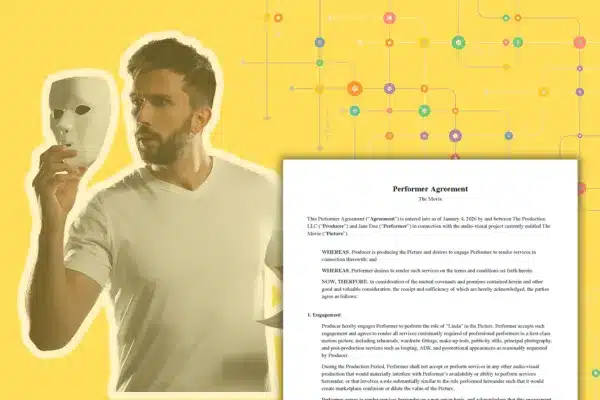

If you’re casting non-union performers and don’t have a signed agreement, you don’t legally own their performance. That means no clean chain of title — and no distribution.
Thoolie’s Non-Union Performer Agreement is drafted by an entertainment attorney and built to satisfy festival, distributor, and E&O insurance requirements from day one. It covers every element of the performer relationship — services, compensation, credit, rights transfer, loan-outs, and chain-of-title protection — in one document built specifically for how indie productions actually work.
This is not a release form. It’s not a generic talent contract adapted from a corporate template. It’s a production-specific agreement built around the rights and obligations that actually matter when your film goes to distribution.
Actor Agreement Template: What Every Indie Filmmaker Needs to Know →
What Filmmakers Get Wrong About Performer Agreements
Assuming a release form is enough
A basic release form covers image and likeness — it does not transfer copyright ownership of the performance itself. Without a work-for-hire agreement and rights assignment, the performer may legally retain rights in their performance. That creates a chain-of-title gap that distributors, sales agents, and E&O insurers flag during delivery review.
Believing ‘non-union’ means low legal risk
Non-union productions have more flexibility — but they have the same ownership requirements. A non-union performer who hasn’t signed a proper agreement has the same legal rights as a union performer who has. Budget level doesn’t affect copyright law.
Skipping agreements on small productions
The size of the production doesn’t determine whether you need an agreement — the distribution destination does. A micro-budget short film that gets into Sundance, gets picked up by a streamer, or triggers E&O insurance review faces the same chain-of-title scrutiny as a $5M feature. The paperwork requirements don’t scale with budget.
Waiting until post-production to get signatures
By the time a film is in post, performers are harder to reach, relationships have changed, and the negotiating leverage has shifted. A performer who knows their signature is needed to complete distribution has more leverage than they did before the shoot. Get agreements signed before cameras roll — every time.
Not accounting for loan-out companies
When a performer works through a loan-out company, the agreement must bind both the company and the individual. An agreement signed only by the loan-out company — without the individual performer also signing — may not fully obligate the performer. This is a specific drafting issue that generic templates consistently miss.
Ready to protect your production?
Thoolie’s Non-Union Performer Agreement is attorney-drafted, E&O-ready, and generated in minutes for your specific production. Covers work-for-hire ownership, name & likeness rights, loan-outs, and chain-of-title protection. $29.99. Instant download.
What This Agreement Secures
A properly executed Non-Union Performer Agreement gives your production:
- Ownership of the performance — work-made-for-hire language and rights assignment that transfers copyright from performer to production company (Read: Who Owns the Rights to a Film? →)
- Name and likeness rights — for use in the film, trailers, promotional materials, streaming platforms, and all future exploitation
- Festival and promotional usage — explicit permission to use the performance in submissions, press materials, and behind-the-scenes content
- Loan-out company handling — correct routing and signature language when a performer works through their own entity
- Credit provisions — defined billing, size, and placement so there’s no dispute at delivery
- Warranties and indemnification — the performer confirms they have the right to enter the agreement and haven’t made conflicting commitments
- Chain-of-title protection — the language distributors, sales agents, and E&O insurers look for during delivery review
In short: you control how the performance is used — now and in the future.very.
Why This Agreement Is Built Differently
Most performer agreements available online are adapted from union templates, corporate talent contracts, or generic freelance agreements. None of those are built around how indie film productions actually work.
This agreement is built specifically for non-union independent film productions — meaning it assumes:
- The production is working outside SAG-AFTRA and needs to protect rights without triggering union obligations
- The film may be micro-budget today but could reach festivals, streamers, or distribution tomorrow
- Compensation may be deferred, flat-fee, or a combination — and needs to be structured correctly for each scenario
- The chain of title needs to be clean enough to pass E&O insurance review and distributor delivery requirements
- Loan-out companies may be involved and need to be handled correctly in the signature block
It is drafted by an entertainment attorneys. It reflects real production and distribution requirements. And it holds up whether your film stays small or unexpectedly succeeds.
Want to Learn More?
- Actor Agreement Template: What Every Indie Filmmaker Needs to Know
- Who Owns the Rights to a Film? A Guide for Filmmakers and Producers
- Film Rights Ownership Checklist: What Every Producer Must Have Before Distribution
- Actor Deal Memo Template: What Every Indie Film Needs
FAQ
A Non-Union Performer Agreement is a contract between an independent producer and an actor working outside SAG-AFTRA or other unions. It defines the performer’s services, compensation, credit, and rights.
Yes. Stock agreements only cover union performers. Any additional non-union talent should still be contracted to ensure clear rights and obligations.
Yes. It secures usage rights and confirms that the producer owns the performance for all media, while the performer retains no independent distribution rights.
Yes. Budget does not determine whether a contract is legally required. This agreement is designed to work at any production scale.
This agreement is drafted to support clean chain of title, which is what distributors, insurers, and platforms review during delivery.