How producers control underlying rights, build financing, and protect chain of title — from the dollar option to the seven-figure acquisition
An Option and Purchase Agreement for film is the legal foundation that allows producers to control underlying rights, build financing, and protect chain of title long before a project reaches distribution.
Most films don’t begin with financing. They begin with control.
Before a producer can responsibly circulate a script, package a project, attach talent, or approach financiers, they must have the legal right to do so. That right typically comes from an Option and Purchase Agreement, a contract that gives a producer temporary control over underlying material without requiring an immediate, full acquisition.
Option agreements are one of the most misunderstood tools in independent film. They are often confused with shopping agreements, treated as informal placeholders, or drafted so loosely that they create more risk than protection. When structured correctly, an option becomes the backbone of a project’s development, financing, and distribution strategy. When handled casually, it is often the reason a project collapses just as momentum appears.
This guide explains how option and purchase agreements actually function in practice, when they are required, how they differ from shopping agreements, and the mistakes that routinely cost producers projects they thought they controlled. It uses real cases, from Stephen King’s one-dollar options to a lawsuit over a studio reversion clause, to show how these provisions play out when money is actually on the line. If you already know you need one, Thoolie’s attorney-drafted Option and Purchase Agreement is built for indie productions. If you want to understand the terms first, keep reading.

What an Option & Purchase Agreement Actually Does
An option is not a purchase. It is a temporary, exclusive right granted by the rights holder, typically a writer, author, or IP owner, to a producer or production company. During the option period, the producer has the sole legal authority to develop, package, and attempt to finance the project.
If the producer succeeds, they exercise the option and acquire the rights under pre-negotiated purchase terms. If they don’t, the option expires and full control returns to the rights holder.
This structure exists for a simple reason: most producers cannot justify purchasing rights outright before knowing whether the project can actually be made. The option creates legal, financial, and strategic breathing room. More importantly, it locks in purchase terms before the project increases in value. Without an option in place, a rights holder can renegotiate or walk away the moment real interest appears.
A Real Example: Stephen King’s “Dollar Baby”
The clearest illustration of how an option separates from a purchase is Stephen King’s famous “Dollar Baby” program. For decades, King has allowed student and amateur filmmakers to option the rights to certain of his short stories for one dollar, on the condition that the resulting film is non-commercial and that rights revert to him afterward.
A one-dollar option is still a real option. It grants exclusive, time-limited control, it does not transfer ownership, and it reverts if the film is never made or never exploited commercially. The dollar figure is almost beside the point. What the agreement does, legally, is identical to a seven-figure studio option: it separates temporary control from permanent ownership. The King example proves that the mechanism, not the money, is what defines an option.
The Option Math: What You Actually Pay, and When
Producers new to options often assume the option fee and the purchase price are the same conversation. They are not. The option fee buys time; the purchase price buys the rights. Here is how a realistic independent-film structure looks on paper.
| STAGE | WHAT YOU PAY | WHAT IT BUYS |
| Initial option (12 months) | $2,500 | Exclusive right to develop, package, and finance. Not ownership. |
| First renewal (12 months) | $3,500 | More time. Renewal fees usually equal or exceed the first. |
| Exercise / purchase | $50,000 | Full acquisition of the rights, triggered when financing closes. |
| Total if exercised | $56,000 | Option fees are often applicable against the purchase price — confirm in the agreement. |
| Total if you walk away | $6,000 | You lose the option fees, not the purchase price. That is the entire point. |
THE POINT OF THE STRUCTURE
If the film gets made, you pay the full purchase price, and your option fees are often credited against it. If the film does not get made, you have risked only the option fees, not the entire purchase price. That asymmetry is the entire reason options exist. You are buying the right to decide later, at a fraction of the cost of deciding now. The figures above are illustrative; option fees commonly run around 10% of the purchase price, but everything is negotiable.

When an Option Agreement Is Not Optional
OOption agreements become mandatory at very specific moments in a project’s life. If you are at any of the following stages, proceeding without an option is no longer a judgment call, it is legal exposure:
- You are pitching the project to investors, sales agents, or financiers
- You are attaching a director or cast
- You are submitting to grants, labs, or fellowships
- You are circulating the script beyond a closed development circle
- You are discussing distribution, presales, or foreign sales
At these stages, you are creating value on rights you do not yet control. If you cannot show a signed option agreement, any serious party will assume the project is legally unsecured, and they will be right. Producers often avoid option agreements out of fear of cost or negotiation friction. In practice, operating without an option creates far more risk once momentum begins.
The Risk of Waiting (Why This Must Be Done Early)
Most producers delay option agreements because nothing feels urgent yet. There’s no financing, no cast attachment, no buyer. That is precisely why this is the most dangerous moment to wait.
The instant interest appears, even informally, leverage shifts. A writer hears excitement and wants revised terms. A rights holder rethinks exclusivity. A manager or agent enters and reframes the deal. At that point, the producer is no longer negotiating from control, but from dependence.
An option agreement only protects you before value is created. It cannot retroactively lock in terms once interest exists. This is why professional producers option material early, even when budgets are small and outcomes uncertain. The option is not about confidence. It is about preserving leverage while it still exists.
Option Agreements vs. Shopping Agreements

Shopping agreements are often presented as a softer alternative to options, but they function very differently.
A shopping agreement typically allows a producer to introduce material to third parties for a limited period, without granting exclusivity or purchase rights. The rights holder usually retains the ability to negotiate directly with buyers. This structure is common in agency or management contexts. It is not a substitute for an option when a producer intends to actively develop, package, or finance a project.
The distinction is leverage. An option grants legal control. A shopping agreement grants permission and very little protection. Many producers spend months developing a project under a shopping agreement, only to lose it when a buyer negotiates directly with the rights holder. At that point, the producer’s only leverage is goodwill.

When and How an Option Is Exercised
Exercising the option is the moment temporary control becomes ownership. The option agreement specifies how and when exercise occurs, typically through written notice and payment of the purchase price or its first installment. This usually coincides with financing, distributor attachment, or a production greenlight.
Timing matters. Exercising too early can strain cash flow. Exercising too late can jeopardize financing if investors require proof of ownership. Well-drafted option agreements anticipate this tension by tying exercise to financing events, allowing escrowed payments, or structuring staged purchase obligations aligned with production milestones.
What Happens When an Option Expires: Understanding Reversion
When an option period ends without the producer exercising their right to purchase, the underlying rights revert to the rights holder. This is called reversion, and how it is handled in the agreement determines whether the project ends cleanly or collapses into a dispute.
Reversion is not automatic in a practical sense. While the legal right to the material may return to the rights holder upon expiration, the chain of title implications, the fate of development materials, and the question of who owns what was created during the option period all depend entirely on what the agreement says.
A vague or silent reversion clause is one of the most common sources of chain of title disputes in independent film. If the agreement does not clearly specify the trigger, the notice requirements, and the process by which rights formally return, both parties can walk away with conflicting beliefs about who controls the material. That conflict surfaces, with full force, during distribution due diligence.
A Real Example: Reversion Is Rarely as Simple as “Rights Snap Back”
A cautionary case shows why reversion language matters. A bestselling author had granted a studio film rights to two of his novels under a 1990s agreement containing a turnaround-style reversion clause: if the studio did not commence principal photography within a set number of years after the option was exercised, the author could recover the rights, but only by reimbursing the studio’s development costs, advances, and payments, plus interest.
When the author moved to reclaim his rights, a dispute erupted over what those reimbursable costs actually were. The studio had, in the meantime, entered a co-production arrangement with another studio, and it sought reimbursement for costs the author argued fell outside the reversion mechanism the original agreement contemplated, including overhead and a third party’s expenses, without clear accounting to verify them. The author sued, seeking a declaration that the repurchase price should not include those costs.
The lesson for producers and rights holders alike: reversion is rarely a matter of rights simply snapping back for free. In most film rights agreements, the party reclaiming rights must repurchase them, and the definition of what must be repaid is exactly where disputes ignite. If your agreement says rights revert “subject to reimbursement of development costs,” that phrase must be defined with precision, or you inherit this exact fight.
Standard Reversion Triggers
Reversion is typically triggered by one of the following:
- The producer abandons the project. Abandonment clauses define what constitutes voluntary surrender and protect the rights holder from a producer who holds rights indefinitely without actively developing the project.
- The option period expires without the producer serving written notice of exercise and paying the purchase price or its first installment. This is the most common trigger and should be specified with precision, not just “the option expires” but what that expiration means procedurally and what happens next.
- The producer exercises the option but fails to begin principal photography within a defined period after exercise. Many option agreements include a production-commencement deadline tied to the purchase.
- The producer fails to secure financing within a defined period. Some option agreements include financing contingencies; these must be drafted carefully to avoid ambiguity about what constitutes confirmed financing.
Notice Requirements
A well-drafted reversion clause specifies that reversion does not occur silently. The rights holder must provide written notice to the producer that the option period has expired and that rights are reverting. The producer should have a defined cure period, typically 10 to 30 days, to respond, correct any administrative error, or exercise the option if they intended to. This notice requirement protects both parties. It prevents a rights holder from asserting reversion without warning and prevents a producer from claiming ignorance of an expiration they had an obligation to track.
What Reverts — And What Doesn’t
Reversion returns the underlying rights to the rights holder. It does not automatically return everything created during the option period. Development materials, including producer-commissioned script drafts, coverage, packaging materials, and creative documents, may remain with the producer depending on the agreement’s language. Most importantly, reversion does not undo the option agreement itself. The agreement, including any representations and warranties made by the rights holder, survives the option term and continues to govern the parties’ relationship with respect to the development period.
The Chain of Title Consequence
From a distribution standpoint, reversion is only clean if it is documented. A producer who re-acquires rights after a reversion, from the same or a different rights holder, must ensure the new agreement clearly acknowledges the prior option, confirms it has expired, and establishes the new grant of rights without ambiguity.
Distributors and E&O insurers look for precisely this kind of continuity. A gap between the expiration of one option and the execution of a new agreement, even a brief one, creates questions about who controlled the material during that gap and whether any third-party claims arose in the interim. Documenting reversion in real time, rather than reconstructing it retroactively, is the professional standard. A simple written confirmation from both parties acknowledging the expiration and the return of rights takes minutes to execute and eliminates years of potential dispute.
RELATED CASE: WHEN OWNERSHIP LOCKS A FILM AWAY
Reversion done poorly is how films disappear. Kevin Smith’s Dogma sat unavailable to rent, stream, or buy for years, not because of demand, but because ownership of the underlying film ended up with a party who had no incentive to exploit it and no obligation to release it. Smith reportedly offered $1 million to buy it back and was turned down. The lesson maps directly onto option reversion: rights need objective triggers and clear paths back, or a project can be stranded with someone who will neither use it nor let it go. See the Distribution Rights resource for the full Dogma breakdown.
When Reversion Works in the Producer’s Favor
Reversion is not only a risk, it can be a strategic tool. Producers who build strong reversion provisions into their option agreements protect themselves from rights holders who attempt to reclaim material mid-development based on disputes unrelated to the option terms.
A clearly drafted reversion clause that specifies objective triggers (rather than subjective assessments of exploitation effort) gives the producer certainty about how long they control the material and what they must do to maintain that control.
It also gives the producer leverage in renewals. A rights holder who knows that reversion requires written notice and a cure period is less likely to assert that rights have lapsed informally or in bad faith.
Common Negotiation Terms Producers Must Understand
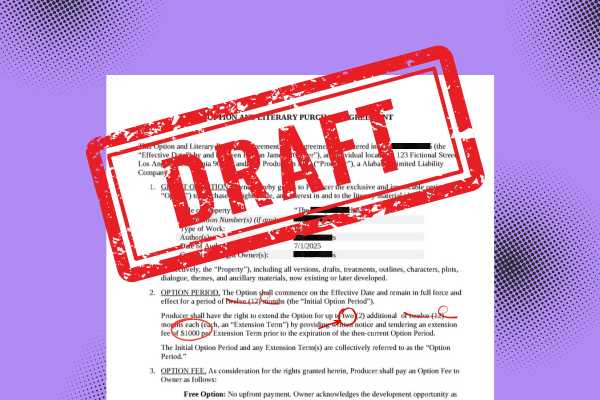
While every deal is unique, certain provisions consistently cause problems when misunderstood. The option term and extensions determine whether you realistically have time to develop the project. Purchase price structures must align with budget realities. Credit provisions must be defined clearly to avoid emotional disputes later. Reserved rights should never undermine financing or distribution. Reversion clauses must allow genuine exploitation before rights snap back. These terms do not exist to complicate deals. They exist to prevent later collapse. To learn more about Option & Purchase clauses read Thoolie’s Option & Purchase Clauses Cheat Sheet.
The Strategic Mistakes That Cost Producers Projects
The most damaging option mistakes are not technical. They are strategic. Some producers over-option material without a development plan, burning goodwill. Others rely on informal emails that collapse under due diligence. Many ignore backend implications, agreeing to participation structures that become unworkable once financing enters. Perhaps most critically, producers forget that option agreements are part of chain of title. A weak option can derail distribution just as easily as missing work-for-hire agreements.
Why Option & Purchase Agreements Are Critical to Chain of Title and Delivery
Option and Purchase Agreements are not just development tools. They are the first link in your chain of title, and distributors treat them that way. When a film reaches financing, sales, or distribution, every party downstream conducts legal due diligence to answer one question: who actually owns this project, and can anyone else claim they do?
Chain of title is the documented proof that ownership flows cleanly from the original rights holder to the production company. If the option agreement at the top of that chain is missing, expired, vague, or poorly drafted, everything built on top of it becomes unstable. This is where many independent films run into trouble. Not because the producer acted in bad faith, but because early control of the material was never locked properly. Distributors do not assume ownership. They require proof.
The Overlooked Risk: “Phantom Ownership” Claims

One of the least discussed but most damaging risks in independent film is phantom ownership. These claims often come from people who were not writers and not rights holders, but who later assert that they were integral to the creation of the project. This can include early development collaborators, producers who shaped the project before paperwork existed, financiers who contributed creatively, directors involved before rights were secured, and advisors, editors, or consultants who believe their contribution created protectable material.
When these claims surface during distribution due diligence, they are not evaluated emotionally. They are evaluated legally. If the producer cannot demonstrate exclusive control of the underlying rights from the outset, distributors and insurers flag the project immediately. Even unproven claims can delay delivery, escrow payments, or collapse a deal altogether. A properly drafted Option and Purchase Agreement establishes, from day one, who controls the material and who does not. It narrows the universe of people who could credibly assert ownership later and creates a clean foundation for every subsequent agreement.
How Option Agreements Protect Delivery and Distribution

From a distributor’s perspective, an option agreement is not just about acquiring rights. It is about eliminating uncertainty. Distributors are not looking for a flawless paper trail. They are looking for clean chain of title, which means uninterrupted, documented control of the underlying rights from the original rights holder through the production entity.
What raises red flags is not that an option was amended, extended, or replaced. It is when there is no clear legal bridge between stages of development. Distributors become concerned when an option expired before packaging or financing began, when extensions were discussed but never documented, when material development occurred outside the option term, when third parties contributed creatively before rights were secured, or when control of the underlying material is implied rather than proven.
Professional producers address this by executing options early, documenting extensions before expiration, using replacement or superseding agreements that clearly acknowledge prior intent, and avoiding backdating or artificial paper fixes that fail due diligence. Clean chain of title is about continuity, not cosmetic perfection.
Why Informal Agreements Fail the Moment Money Appears
Emails, texts, and “we’re good for now” understandings often function, until they don’t. The moment financing, talent, grants, or distribution enter the picture, informal agreements fail scrutiny. Investors and sales agents do not evaluate intent. They evaluate legal authority.
At that point, an unsigned or loosely drafted option is not just weak, it is a liability. It signals that the project is legally underdeveloped and raises immediate red flags. A professionally drafted Option and Purchase Agreement does more than secure rights. It signals seriousness. It tells financiers and distributors the project is controlled, structured, and capable of closing.
CIRCULATING MATERIAL WITHOUT A SIGNED OPTION?
Every pitch, talent attachment, and financing conversation you have without a signed option creates leverage for the rights holder, not you. Thoolie’s Option and Purchase Agreement is for indie productions, built around real development timelines, phased financing, and the due diligence scrutiny that distributors and sales agents apply. $79.99. Instant download.
Backend Considerations Most Producers Miss
Backend participation is often treated casually at the option stage. This is a mistake. Backend defines how profits flow after recoupment, how waterfalls operate, and how multiple stakeholders coexist. Even small percentages can have outsized consequences once investors, sales agents, and distributors are involved. Backend is not a goodwill gesture. It is financial architecture.
Using the Right Option Agreement Matters
Not all option agreements are built for independent film. Many templates are either overly simplistic or written for studio deals that ignore indie realities. Both create problems later, particularly when financing, backend, or international sales enter the picture.
Thoolie’s Option and Purchase Agreement was built specifically for independent producers. It reflects real development timelines, phased financing, backend participation, and the scrutiny applied during due diligence. If you are circulating material, attaching talent, or seeking financing, this is not a document to postpone. It is the legal foundation everything else sits on.
FAQs
Yes. The moment you pitch to an investor, sales agent, financier, or festival, you are creating value on rights you may not control. Any serious party will ask to see proof that you have the legal authority to develop the project. Without a signed option, you are pitching someone else’s property, and the rights holder can renegotiate or walk away the instant your pitch generates interest.
No, and this is backwards from how most producers think. Financiers require proof of ownership before they commit, so “I’ll option it once the money is real” creates a deadlock: you can’t get the money without the rights, and you’re trying to get the rights only after the money. Worse, once financing interest appears, the rights holder’s leverage jumps and your terms get more expensive. Option early, while the material is still cheap to control.
Trust is not the issue. An option protects both of you from ambiguity, from third parties who enter later, and from honest disagreements about what was agreed. It also protects the project itself: when a distributor’s E&O insurer reviews chain of title, they do not accept “we trust each other” as documentation. A signed option is what converts a good relationship into a financeable, insurable asset.
Yes, and Stephen King’s one-dollar “Dollar Baby” options prove the point: even a non-commercial student film gets a real, written option with defined terms and reversion. The dollar amount can be tiny, but the document still needs to exist. If your short ever gains an audience, wins at festivals, or attracts a buyer, clean underlying rights are what let you capitalize on that instead of scrambling to reconstruct them.
Sometimes, but it is far more expensive and risky than doing it right the first time. Retroactive fixes raise exactly the red flags distributors look for: gaps in the chain of title, development that happened outside a documented option term, and questions about who controlled the material in between. Backdating is not a solution and fails due diligence. The clean path is a properly executed option at the correct stage, not a paper fix later.
Most free templates are either too simplistic to survive due diligence or written for studio deals that ignore indie realities like phased financing, backend participation, and the reversion precision this guide describes. The option sits at the top of your chain of title, so a weak one can derail distribution as easily as a missing work-for-hire agreement. This is the one document where getting it right the first time is cheapest.
Final Takeaway
Option and purchase agreements are not paperwork. They are strategy. A well-structured option gives producers time, control, and leverage. A poorly handled one can destroy trust, stall financing, or collapse distribution. From Stephen King’s one-dollar options to seven-figure studio acquisitions, the mechanism is the same: separate temporary control from permanent ownership, and document every step so that ownership can never be credibly challenged. Professional filmmakers treat options not as formalities, but as the legal infrastructure that allows creativity to become commerce.
FULL ACCESS DOWNLOAD: OPTION & PURCHASE DEAL TERM SHEET
Full Access members can download the companion Deal Term Sheet: a fill-in working document with a “Your Deal” column and a “Guidance / What to Look For” column covering option terms, purchase terms, grant of rights scope, participation and credit, and reversion and turnaround. It turns this guide into the actual checklist you take into a negotiation.
Also relevant to your production:
- Film Rights Ownership Checklist → Everything that must be documented before a distribution conversation begins.
- What Must a Producer Agreement Include? → Find out what a producer actually does.
- Film LLC Guide for Indie Filmmakers → The entity that holds the rights your option secures.
- How Film Distribution Rights Work for Indie Filmmakers → Where the Dogma story is told in full, and how rights lock-ups actually happen.
- Indie Film Delivery Checklist → Everything you need to deliver your finished film.
- Every Contract You Need for a Short Film → The full paperwork map, even at the dollar-option level.
- What Happens When a Film Option Expires: A Producer’s Guide → Is your option expiring? Start here.
- Copyright Termination Rights for Filmmakers → Learn more about reversion.