

🎬 Why This Matters
You’ve got a camera, a script, and a cast ready to go. Your budget? Under $20K.
You might even be using SAG-AFTRA’s stock contracts — the ULB or Micro-Budget agreements — because they make working with professional actors possible on a shoestring. But here’s the catch: SAG’s paperwork isn’t designed to protect you everywhere else.
Festivals. Streaming. Distribution. Long-term rights.
That’s where filmmakers get blindsided.
This guide breaks down the legal traps most ultra-low budget filmmakers fall into — and shows you how to avoid them without a $100K legal bill.
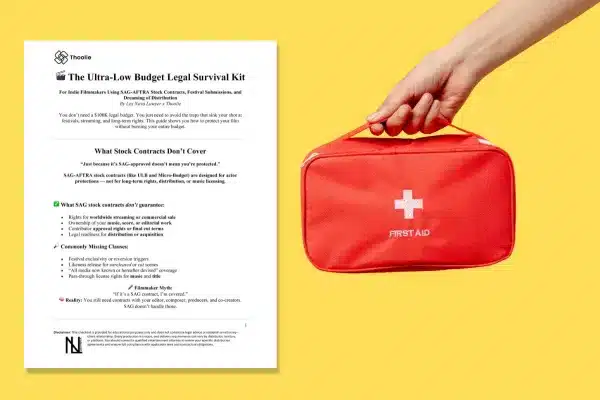
📄 Prefer the quick version? Download the Ultra-Low Budget Legal Survival Kit Checklist for a bulletpoint breakdown you can keep on set.
Legal Risks for Ultra-Low Budget Filmmakers
When you’re working with a $20K budget, every dollar counts. But here’s the truth: cutting corners on contracts can cost you more than your entire budget down the road.
Even with a signed SAG agreement, you still need:
- A Work-for-Hire Agreement for your editor, composer, and crew.
- A Music License Template that covers all media, worldwide, in perpetuity.
- A Festival Submission Release if you’re sending an unfinished cut.
Without these, you may not have the rights you think you do — and that can kill a streaming deal before it even starts.
Why SAG-AFTRA Stock Contracts Aren’t Enough
SAG’s templates are designed for actor protections, not your ownership rights. That means they don’t guarantee:
- Worldwide streaming rights
- Ownership of your score or editing work
- Final cut approval
- Pass-through music licenses (so streamers can sublicense)
📌 Example: If your composer doesn’t sign a Work-for-Hire, they may own the score. That means Netflix can’t use it unless you pay them… again.
For missing protections, you’ll want templates like:
- Composer Work-for-Hire Agreement
- Editor Work-for-Hire Agreement
Festival Submission Legal Checklist
Festival laurels look great on a poster. But they won’t get you distribution if your rights aren’t clear.
MYTH: “Festivals don’t care about licensing.”
Reality: Some do. And buyers definitely do.
MYTH: “I can use temp music until I sell it.”
Reality: If your cut gets leaked or screened publicly, you could face a takedown or lawsuit.
✅ Before you spend $300+ on entry fees, ask yourself:
- Am I building buzz?
- Targeting a distributor?
- Planning to self-release?
And make sure you have a signed Festival Submission Release and cleared music before hitting “Submit.”
The Distribution Contract Essentials
You finally get a “yes” from Amazon or a streamer. Now comes the delivery checklist.
Most buyers ask for:
- Signed Work-for-Hire agreements for every key creative (editor, composer, producers).
- Chain of title documents proving you own everything.
- Music licenses with all-media, worldwide, in-perpetuity rights.
- Proof of clearance for logos, brands, and artwork.
⚠️ Used temp music? Let someone keep “final cut” via email? Didn’t get your editor to sign?
That’s how distribution deals vanish.
How to Avoid the Most Common Mistakes
Here’s the fast-track version:
- Get it in writing. Verbal agreements don’t count.
- Clear your music early. Last-minute licensing can drain your budget.
- Don’t skip likeness releases. Even for people you cut from the final edit.
- Plan for profit participation. If you promise backend, define it clearly.
💡 Bonus tip: Always read festival terms before submitting. Some limit your distribution options for months.
The Bottom Line
SAG stock contracts get you started. The right legal documents get you across the finish line.
Protect your rights now, and you’ll save yourself from expensive headaches later — and actually be able to deliver your film when opportunity knocks.
📄 Want the quick checklist? Download the Ultra-Low Budget Legal Survival Kit PDF and keep it in your production binder.