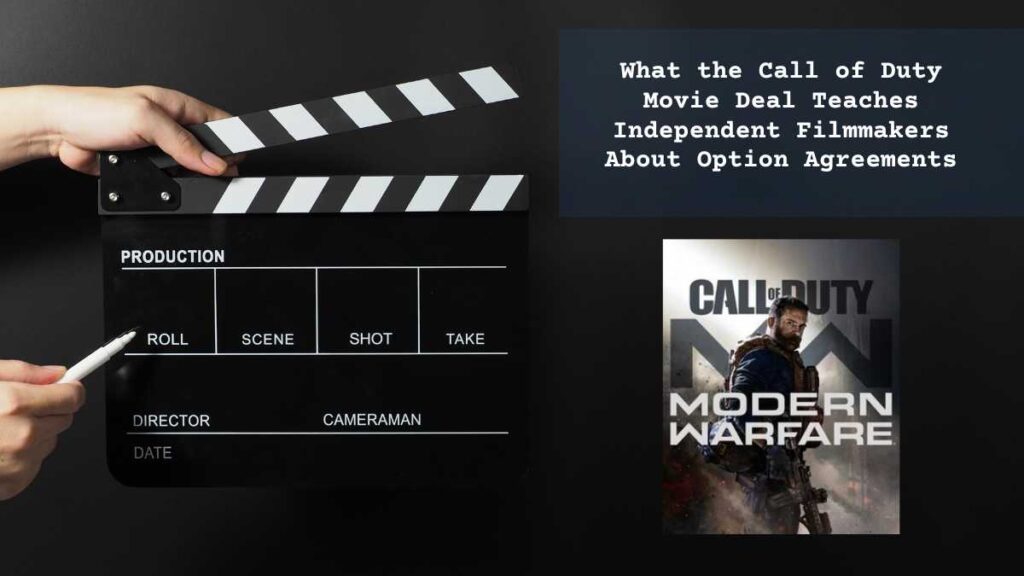

Call of Duty has sold more than five hundred million copies. It has generated over thirty billion dollars in revenue. It is, by any measure, one of the most valuable pieces of entertainment intellectual property in existence.
Activision first announced plans for a Call of Duty cinematic universe in 2015. It took nearly a decade to actually get a deal signed. Paramount finally locked in the rights in September 2025, with Taylor Sheridan and Peter Berg attached to write, produce, and direct. On July 18, 2026, the project was confirmed to be set in the Modern Warfare universe, with a theatrical release date of June 30, 2028.
Here is the detail that matters most for independent filmmakers, and the one most coverage of this deal glosses over.
Paramount did not buy Call of Duty. They bought the right to make one film.

One Film, Not a Franchise
According to multiple industry sources, the agreement between Paramount and Activision is scoped specifically to a single feature film, with the potential for Paramount to later negotiate additional films or a television series. That expansion is not automatic. It is not included in what was licensed. It would require a separate negotiation, on separate terms, if and when Paramount wants it.
This is a meaningfully different deal than an open-ended grant of “the Call of Duty franchise.” Activision retained control over everything beyond the one film they agreed to license. If the movie succeeds, Activision is not obligated to hand over sequel rights, spinoff rights, or television rights on the terms already established. They negotiate again, from a position that is almost certainly stronger than it was before anyone had proof the property could work as a film.
That is not an accident. It is what a properly scoped option and license agreement is supposed to do.
The Mistake Most Independent Filmmakers Make
When a filmmaker options a novel, a true story, a podcast, or someone else’s screenplay, the temptation is to treat the deal as binary: either you have the rights to make the movie, or you don’t. In practice, “the rights to make the movie” is not one thing. It is a bundle of separate rights that can be licensed together or separately, and a well-drafted option agreement specifies exactly which ones are included.
Ask yourself the same questions Activision and Paramount had to answer before signing:
Does the option cover one film, or does it extend to sequels and remakes? A rights holder who grants “motion picture rights” without qualification may be handing over far more than they intended. A rights holder who grants rights to “one feature-length motion picture” retains everything else by default.
Does it include television rights? Film and television rights are frequently treated as separate grants in modern entertainment deals, particularly as streaming has made television adaptations just as valuable as theatrical ones. An agreement silent on this point invites a dispute the moment either side wants to develop a series.
Does it include merchandising, video game, or other derivative rights? For source material with any brand potential, these rights can eventually be worth more than the film itself. They should never be assumed to travel with a film option by default.
What happens if the option lapses? If the producer does not exercise the option and make the film within the agreed window, do all rights revert cleanly to the original owner? Vague or missing reversion language is one of the most common defects Thoolie sees in option agreements submitted for review, and one of the most expensive to fix after the fact.

Why This Matters More as the Underlying Work Gets More Successful
Activision did not need to give away more than one film’s worth of rights, because the leverage was entirely on their side. The franchise was already worth thirty billion dollars before Paramount ever sat down at the table. Waiting to license only what was needed, on terms negotiated from strength, is precisely why the eventual deal could be structured this narrowly.
Most independent filmmakers option material long before anyone knows whether it will succeed. That is normal, and it is often the only way a project gets made at all. But the same principle still applies at a smaller scale. A writer who is asked to sign over “all rights, including all sequels, remakes, and derivative works, in perpetuity, throughout the universe” in exchange for a modest option fee on an unproduced screenplay is giving away exactly what Activision spent a decade protecting, for a fraction of the leverage.
The lesson is not that every writer should hold out for a Paramount-sized deal. Most never will, and that is fine. The lesson is that the scope of what you are licensing should be a deliberate decision, spelled out in the agreement, rather than an accident of boilerplate language neither party actually read closely.
What to Do Before You Option Anything
If you are the producer optioning someone else’s work, define exactly what you need to make your film, and resist the temptation to ask for more just because a broader grant is available. Overreaching on rights you do not need creates friction in the negotiation and can make the deal harder to close for no real benefit.
If you are the writer or rights holder granting the option, read the grant-of-rights clause more carefully than any other paragraph in the agreement. It is usually the shortest section and the most consequential. Confirm what happens to your reserved rights, what triggers reversion, and whether anything beyond the film itself is included.
Thoolie’s Option and Purchase Agreements Guide walks through this clause by clause, and the Option & Purchase Clauses Cheat Sheet is built specifically to help you spot an overbroad grant before you sign one.
Call of Duty took a decade to become a movie. Whatever you are optioning probably will not take that long. But the discipline behind that deal, license only what you need, keep what you do not, and negotiate the rest when your leverage improves, applies at every budget level.