
On most indie productions, the makeup artist is hired quickly.
A few texts. Maybe a call. Sometimes just a DM.
Everyone’s focused on getting through the shoot.
And for a while, that works…until something goes sideways.
An actor has a reaction to a product.
Continuity doesn’t match between takes.
A dispute comes up over kit fees or hours.
Or later—when the film actually has momentum—someone asks for paperwork that doesn’t exist.
That’s usually the moment producers realize the makeup artist wasn’t just “helping out.”
They were part of a department that carries real responsibility on set.
A makeup artist agreement is what turns that informal relationship into something the production can actually rely on.

What a Makeup Artist Agreement Actually Covers
In film, this isn’t just a generic freelance contract.
You’re not hiring someone for a one-off service—you’re bringing them into a system that has scheduling pressure, safety concerns, and downstream distribution requirements.
A proper agreement reflects that.
It defines what the makeup artist is expected to do day-to-day, how they’re compensated, how their materials are handled, and how their work fits into the larger production.
It also addresses things that don’t come up until later—like ownership, insurance, and what happens if something goes wrong.
Those are the pieces most productions overlook.

Why This Role Carries More Risk Than People Think
Makeup is one of those departments that feels low-risk—until you look a little closer.
You’re dealing with products being applied directly to actors’ skin, sometimes for long shooting days, sometimes under difficult conditions.
If hygiene standards aren’t clear, or if communication breaks down around sensitivities or allergies, the issue isn’t just creative—it’s liability.
There’s also the continuity side of it. If a look doesn’t match across scenes, that becomes a problem in post. And by then, it’s expensive to fix.
None of that is about blaming the makeup artist. It’s about clarity.
Because when expectations aren’t spelled out, responsibility becomes unclear—and that’s where problems start.
Where Most Indie Productions Get This Wrong
What usually happens is one of two things.
Either there’s no agreement at all, or there’s a generic services template pulled from somewhere online.
Neither is built for film.
A generic contract doesn’t account for how productions actually run—long days, shifting schedules, reshoots, department coordination. It doesn’t address kit usage in a meaningful way, or what happens if the scope expands mid-shoot.
And when there’s no agreement at all, everything is based on assumptions.
Those assumptions tend to fall apart at the worst possible time—mid-production, or right when the project starts to gain traction.
If you’re already in pre-production and don’t have this locked in yet, this is exactly the moment to fix it. Because once shooting starts, even small issues—hours, kit use, expectations—turn into delays, costs, or conflicts that are much harder to unwind.
This is one of those decisions that feels optional early…and expensive later.
The Terms That Actually Matter
What separates a real makeup artist agreement from a basic template isn’t length—it’s specificity.
You’re defining the scope of the role in a way that matches how film production works. That includes whether the artist is handling makeup only or also hair, whether special effects work is involved, and how continuity is managed across shoot days.
Compensation is another area that needs clarity. Not just the rate, but how kit fees are handled, whether overtime is expected, and what happens if the schedule shifts—which it almost always does.
Then there’s the less obvious side of it.
Hygiene and safety expectations need to be explicit. Not because you expect issues, but because if something does come up, you want it clear that proper standards were required.
And finally, there’s ownership.
Even though makeup isn’t something you “own” in a traditional sense, the visual result becomes part of the film. Your agreement should make it clear that the production has the right to use that work in the picture and in marketing without any downstream claims.
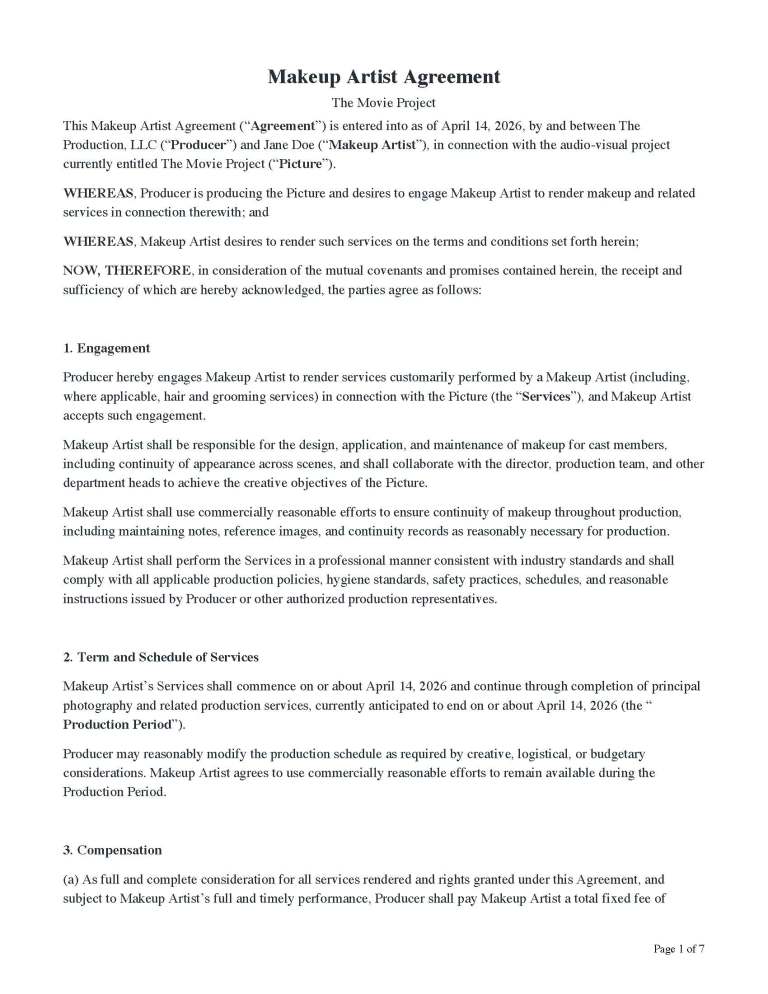
What Does a Makeup Artist Contract Actually Look Like?
Instead of listing terms abstractly, it helps to understand how these agreements are structured in practice.
A typical film makeup artist contract will include language that:
- Defines the makeup artist’s services in connection with the production
- Confirms that all work performed is done on a work-for-hire basis
- Outlines compensation, including any kit or materials fees
- Requires compliance with on-set safety and hygiene standards
- Grants the production the right to use the results of the services in the film and in marketing
In many cases, these agreements also include provisions addressing scheduling changes, reshoots, and coordination with other departments.
That level of detail is what separates a film-specific agreement from a generic freelance template.
Is a Makeup Artist Contract Different for Film vs Freelance Work?
Yes—and this is where a lot of confusion comes in.
A standard freelance agreement doesn’t account for how film productions operate. Film contracts typically include work-for-hire language, production-specific scheduling terms, and rights needed for distribution and marketing.
That difference is what allows the project to move forward without legal issues later.
Do Small Productions Really Need This?
This is where most people hesitate.
If it’s a short film, a small shoot, or a project with friends, it can feel unnecessary to formalize things.
And in some cases, nothing goes wrong.
But the issue isn’t the shoot itself—it’s what happens after.
If the film goes to a festival, gets picked up, or even just gets reviewed for insurance, the question isn’t how the production felt at the time. It’s whether the paperwork supports what was done.
That’s when informal arrangements start to break down.
Built for the Moment Your Film Levels Up
Most productions don’t think about contracts because everything feels manageable.
Until it isn’t.
Until there’s outside interest.
Until someone asks for deliverables.
Until the project needs to stand up to scrutiny beyond the set.
That’s the moment when gaps in paperwork become real problems.
This agreement is designed so you don’t have to go back and fix those issues later—when it’s harder, more expensive, or no longer possible.

Why This Agreement Is Different
There’s no shortage of templates online.
The issue is that most of them aren’t written with film production—or distribution—in mind.
This agreement is.
It’s drafted from the perspective of how projects actually move forward, what insurers look for, and what distributors expect to see.
It’s built to work on a small shoot, but also to hold up if that project turns into something bigger.
Create Your Makeup Artist Agreement
If you’re hiring a makeup artist—even for a small project—this is one of those places where doing it right early makes everything easier later.
Create your Makeup Artist AgreementFAQ
If you want clarity around expectations, payment, and responsibility—yes. Even on smaller productions, having an agreement helps avoid issues during and after the shoot.
It typically covers services, compensation, materials or kit usage, scheduling, safety expectations, and how the work can be used by the production.
They are. Makeup artists are part of the crew and are usually hired under a crew-style agreement rather than a simple freelance contract.
Often the makeup artist brings their own kit, which is why agreements usually address kit fees and responsibility for materials.
Without one, expectations can become unclear, disputes are harder to resolve, and the production may run into issues later during distribution or insurance review.