Protect Your Ownership. Avoid Lawsuits. Keep Your Film Yours.
If you’re hiring anyone—an editor, composer, DP, designer, animator, actor, or social media creator—you’ve probably heard that you need a “work-for-hire agreement.”
But what does that actually mean?
Does calling something “work for hire” automatically make it one?
Does paying someone guarantee you own what they created?
And most importantly:
How do you make sure your film is legally yours when it comes time to distribute, license, or monetize it?
This guide breaks down every essential piece of Work-for-Hire law in the film world, and shows you exactly where most indie filmmakers unknowingly sabotage their own ownership.

Why You Need a Work-for-Hire Agreement
Under U.S. copyright law, the creator—not the person paying—is the default owner of the work.
If your editor cuts a scene, they own the cut.
If your composer scores the film, they own the music.
If your designer creates the poster, they own the artwork.
Payment does not transfer rights.
The only way to guarantee ownership is:
- A valid work-for-hire clause, and
- A backup copyright assignment (because WFH doesn’t always apply)
If you don’t have both, you may not legally own the materials required for:
- festivals
- platforms
- distributors
- investors
- sales agents
- insurance providers
👉 If you want the shortcut:
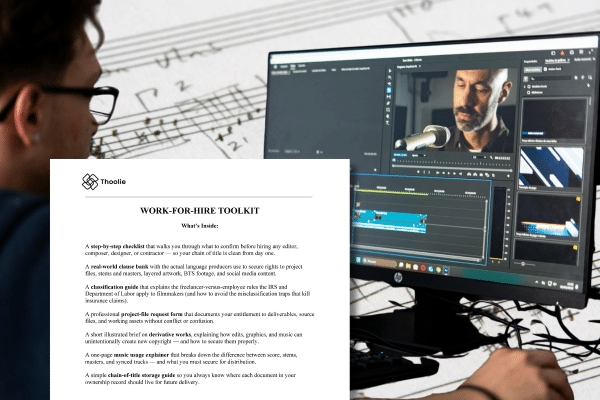
Use Thoolie’s lawyer-drafted Work-for-Hire Agreement, designed specifically for indie producers, editors, composers, and creatives.

What Is a Work-for-Hire Agreement in Film?
A work-for-hire agreement is a contract stating that the person being paid to create something—your editor, composer, designer, DP, marketing contractor, or even actor—assigns ownership of their work to you, the hiring party.
This covers creative contributions such as:
- original music
- edited footage
- set design and props
- graphic design and title treatments
- visual effects
- character artwork
- branding or packaging
- some performances
Unless the creator signs a written agreement, they own the copyright, even if you paid for every second of it.
According to the U.S. Copyright Office, Work-for-Hire rules are:
- narrow,
- specific,
- often misunderstood, and
- must be spelled out in writing
Otherwise, the work is not considered work-for-hire under the law.
Where Most Indie Filmmakers Go Wrong
Independent filmmakers consistently fall into the same traps:
❌ “If I paid them, I own it.”
Incorrect. Payment does not equal ownership.
❌ “If I call it ‘work for hire,’ that makes it one.”
Wrong. It must meet legal requirements.
❌ “They sent me the files—so we’re good.”
Delivering files is not the same as transferring copyright.
❌ “I hired their loan-out company—so I’m protected.”
Dangerous assumption.
If the individual creator didn’t assign rights, you may still not own the material.
👉 For a full explanation of these traps, see:
Do You Own What You Paid For? →
Editor or Composer? Use This Contract or Risk a Lawsuit →
What Loan-Out Companies Change About Ownership →
Freelancer vs Employee in Filmmaking →

Read the Deep Dives: What Work-for-Hire Doesn’t Cover
Work-for-Hire is powerful, but it doesn’t fix every legal issue.
To protect your film, you need to understand where the edges are.
1. Do You Own What You Paid For?
Even if you paid for the edit or the music, the creator still owns it unless they sign a contract.
2. Editor or Composer? Use This Contract or Risk a Lawsuit
These roles generate the most copyright disputes in indie film.
3. Loan-Out Company Loopholes
Signing the LLC but not the individual creates huge ownership gaps.
4. Freelancer vs Employee in Film
You can’t just call someone a freelancer. IRS rules apply—especially on set.
This cluster of articles exists for one reason:
Work-for-Hire is only one piece of your legal foundation.
The rest determines whether distributors, festivals, and insurers accept your film.
Pro Tip: Always Include the “Assignment Clause”
Even if your contract has Work-for-Hire language, courts sometimes reject it.
That’s why Thoolie’s agreement includes:
✓ Work-for-Hire clause
and
✓ Backup copyright assignment
Two paths to ownership.
Two legal safeguards.
One clean chain of title.
Platforms like Netflix and Amazon often require both.
Wrapbook doesn’t explain this.
LegalZoom doesn’t include it.
Thoolie does—because we’ve seen how easily films get derailed without it.
Ready to Own What You Paid For?
Thoolie’s Work-for-Hire Agreement Template is:
- Lawyer-drafted
- Built specifically for indie film productions
- Optimized for editors, composers, designers, and creators
- Includes loan-out signatures and inducement letters
- Includes assignment and work-for-hire language
- Accepted by festivals, distributors, and insurers
If you need clean ownership, clear rights, and a chain-of-title document you can show to a sales agent or platform:
👉 Customize the Work-for-Hire Agreement →
Related Resources
Link these by anchor text:
- Do You Own What You Paid For?
- Editor or Composer? Use This Contract or Risk a Lawsuit
- What Loan-Out Companies Change About Ownership
- Freelancer vs Employee in Film: What the Law Actually Says
- Film LLC Operating Agreement
- Self-Distribution Checklist
Want More Legal Resources for Indie Filmmakers?
Visit the Creator Vault for:
- templates
- checklists
- clause banks
- legal guides
- negotiation breakdowns
Built for real creators—not corporations.
FAQ
No. If you control their schedule, tools, or process — they may be an employee under the law.
You may not legally own the footage, music, or materials — and you could be sued, pulled from festivals, or rejected by distributors.
We include everything you need to secure rights, even from loan-out companies, and protect against misclassification. Most online templates don’t.
es. These are the roles where Work-for-Hire matters most and where disputes most often arise.