Here’s a legal nightmare nearly every filmmaker eventually hears about—usually too late:
You hire an editor, a composer, or a graphic designer. They deliver the work, you pay them, and the project moves forward… until a festival, platform, or distributor asks for chain of title documents.
And suddenly you discover:
You don’t actually own what you paid for.
This trap is one of the biggest—and most preventable—pitfalls in independent filmmaking.

🎬 You Paid for the Work — But Do You Actually Own It?
In filmmaking, paying someone to create something does not give you legal ownership.
You can spend thousands on editing, scoring, illustrations, or marketing assets…
And still have zero copyright rights.
Distributors see this constantly. So do insurers. So do lawyers.
And unfortunately—so do judges.

🧠 The Legal Rule: Creators Own What They Create (Unless You Say Otherwise)
Under U.S. copyright law, the creator of a work is automatically the copyright owner—even if someone else funded it.
Unless you have:
- a Work-for-Hire Agreement, or
- a written copyright assignment
…the creative contractor still owns the work.
This means:
- your editor may own your locked cut
- your composer may own the master recording
- your poster designer may control the artwork
- your VFX artist may control the final rendered files
If your project reaches distribution, investors, or commercial licensing, these issues become immediate roadblocks.
For how these rules work specifically in film, read:
👉 Work-for-Hire Agreement for Film: The Complete Indie Guide

⚠️ Real-World Examples of This Trap
Example 1 — The Composer Standoff
A short film wins a festival award.
But the composer—who worked without a contract—refuses to allow distribution unless they receive backend royalties and creative approval.
Example 2 — The Editor’s “Derivative Work” Claim
An editor delivers a cut, gets paid, then denies permission for the filmmaker to release it.
Because they created the edit, they claim it’s a derivative work they own.
The filmmaker either pays again… or recuts the entire film.
👉 See also: Editor Work-for-Hire Guide
Example 3 — The Designer Who Files a Claim
A designer creates the film’s poster.
Months later, the production modifies it for distribution.
The designer files a copyright claim—because legally, they own the design.
👉 Related: Loan-Out Company & Work-for-Hire Loophole
These problems are common, expensive, and entirely preventable.
🛠️ How to Avoid This: Use a Work-for-Hire Agreement
A proper Work-for-Hire Agreement solves all of this by:
✔ 1. Declaring the contractor a non-employee independent contractor
(Important for IRS rules—see: Freelancer vs Employee in Filmmaking)
✔ 2. Stating the work is a Work Made for Hire under U.S. copyright law
This alone is not enough—but it sets the foundation.
✔ 3. Including a backup copyright assignment
This guarantees ownership even if Work-for-Hire doesn’t apply.
✔ 4. Defining deliverables, versions, formats, and deadlines
Clear expectations eliminate most conflicts.
✔ 5. Addressing usage rights and distribution rights
Especially critical for streaming, festivals, marketing, and trailers.
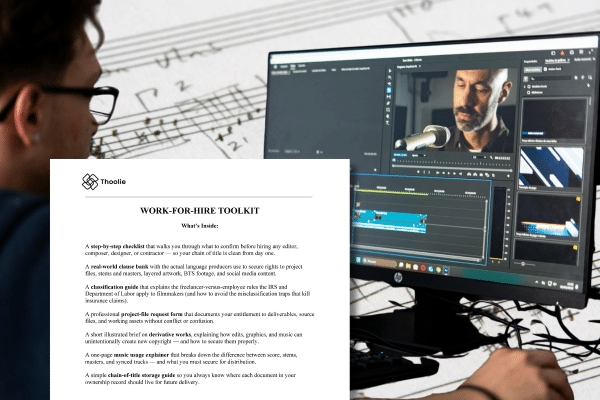
For a template built specifically for filmmakers, editors, composers, and creative contractors:
👉 Work-for-Hire Agreement Template
Don’t Just “Trust” — Get It in Writing
Even if you’re working with:
- a friend
- a classmate
- a fellow film student
- a collaborator from a past project
…trust is not ownership.
Contracts aren’t about distrust—they’re about clarity and protection.
Your contract should unambiguously state:
“I’m hiring you to create this work. When I pay you, I own it. Period.”
This protects the creator and the production.
📚 Related Posts You’ll Want to Read
Link these exactly as anchor text:
- 👉 Editor or Composer? Use This Contract or Risk a Lawsuit
- 👉 Freelancer vs Employee in Film: What the Law Actually Says
- 👉 What Loan-Out Companies Change About Copyright Ownership
- 👉 Work-for-Hire Agreement for Film: The Complete Indie Guide
FAQ
Correct. Payment alone does not transfer copyright. Ownership only transfers with a signed Work-for-Hire Agreement or copyright assignment.
Invoices do not transfer copyright. Emails usually don’t either unless they include specific legal language.
Yes—but only if the contractor agrees to sign a retroactive assignment. Otherwise, you may be legally stuck.
Yes. In fact, loan-outs complicate ownership even more.
Read: Loan-Out Company Work-for-Hire Loophole
Absolutely. Distributors need clear chain of title showing you own every copyrighted element.
Looking for the full breakdown?
👉 Read the Work-for-Hire Agreement for Film: The Complete Indie Guide.