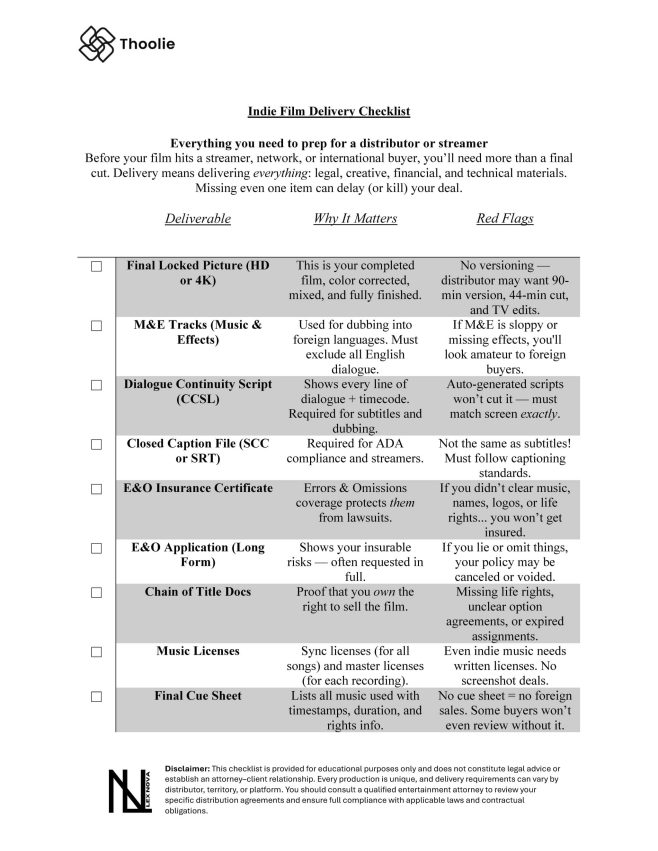
Finishing your film is not the finish line. Before a distributor, streamer, network, or international buyer will sign on, they need more than the movie file. They need a complete delivery package — legal, creative, technical, and financial materials that prove the film is clean, cleared, and distribution-ready.
This checklist covers every item in a standard indie film delivery package. Each legal item links directly to the Thoolie agreement that covers it. Work through it before you start approaching buyers — the time to find gaps is before someone is waiting on your paperwork.
Quick Answer
A complete indie film delivery package includes: final locked picture, M&E tracks, CCSL, closed captions, E&O insurance, chain-of-title documentation, music licenses and cue sheet, signed cast and crew agreements, location and materials releases, copyright registration, title report, clearance log, MPAA rating or exemption, final credits, graphic assets, and trailers. Each is covered in detail below.
Why Delivery Requirements Matter More Than You Think
Most indie films don’t stall at the creativity stage. They stall at the delivery stage — when a distributor or platform asks for paperwork the production never properly assembled.
Delivery isn’t a formality. It’s the legal and technical audit of your film. A single missing item — an unsigned crew agreement, an unlicensed music track, a location release that was never collected — is enough to delay a deal, trigger expensive remediation, or cause a buyer to walk away entirely.
The producers who move fastest through distribution are the ones who treated delivery as part of production — not as an afterthought after the final cut.
The most common delivery failure
Chain-of-title gaps. A missing crew agreement, unsigned performer release, or vaguely worded composer deal gives a third party a potential claim to part of your film. E&O insurers flag these gaps, distributors reject delivery because of them, and fixing them retroactively — when the other party knows their signature is needed — is expensive and slow.
Complete Delivery Requirements — At a Glance
The table below lists every standard delivery item, what it covers, the most common failure point, and the Thoolie agreement that covers it where applicable.
| Deliverable | What it covers | Most common failure | Thoolie agreement |
| Final Locked Picture (HD or 4K) | Completed film — color corrected, mixed, fully finished | Distributors may require alternate cuts (theatrical, broadcast, TV) | |
| M&E Tracks | Music and effects without dialogue — for foreign dubbing | Sloppy M&E mixes hurt foreign sales | |
| CCSL (Dialogue Continuity Script) | Every line of dialogue with timecode for subtitling | Auto-generated scripts don’t match the final cut | |
| Closed Caption File (SCC or SRT) | ADA compliance and streaming platform requirement | Captions ≠ subtitles — must meet captioning standards | |
| E&O Insurance Certificate | Protects distributor from lawsuits arising from the film | No policy if music, names, logos, or life rights aren’t cleared | |
| Chain of Title Documentation | Proves the production company owns all rights to sell | Missing contributor agreements, expired option agreements | Work-for-Hire, Performer, Crew Agreements |
| Music Licenses | Sync license (composition) + master license (recording) | Handshake deals with musician friends — not enforceable | Composer Agreement |
| Final Music Cue Sheet | All music in the film with timecodes, duration, rights info | Many buyers won’t review a film without it | |
| Cast & Crew Agreements | Signed agreements proving rights to all performances and work | Verbal agreements, missing work-for-hire language | Performer, Crew, WFH Agreements |
| Location & Materials Releases | Permission to film and use footage of locations and property | Missing releases = blurred logos or pulled scenes | Location Agreement, Materials Release |
| Copyright Registration | Formal ownership record with the U.S. Copyright Office | Filing late can forfeit statutory damages | |
| Title Report | Confirms film title doesn’t infringe existing trademarks | Last-minute cease-and-desist from an existing rights holder | |
| Clearance Log | Lists all visible IP and whether each element is cleared | Background posters, T-shirts, product labels all count | |
| MPAA Rating or Exemption | Required for theatrical and many streaming deals | Unrated films face distribution restrictions | |
| Final Credits List | Accurate crediting to avoid disputes and union issues | Credit errors can trigger legal action | |
| Graphic Assets | Posters, stills, social banners — full promotional kit | Buyers expect high-res assets ready to use | |
| Trailers (Multiple Durations) | 15-sec, 30-sec, and 90-sec cuts required separately | Trailer music needs separate licensing — often forgotten |
The Legal Deliverables — What Each One Requires
The technical deliverables — picture, sound, captions — are well understood. The legal deliverables are where most indie productions run into problems. Here’s what each one actually requires.

Chain of Title Documentation
Chain of title is the documented ownership history of every element in your film. It answers the question distributors and insurers actually care about: can you prove the production company owns the right to sell this film?
A complete chain of title includes signed agreements for every contributor who created original work — the director, cinematographer, editor, composer, writer, and any crew member whose work product is in the film. Each agreement must include work-made-for-hire language or a full assignment of rights.
Most E&O insurers require a chain-of-title memo from an entertainment attorney summarizing the ownership history before they’ll issue a policy.
- Chain-of-title memo from an entertainment attorney — required by most E&O insurers
- Screenplay option or purchase agreement — confirming the production company acquired all rights to the script → Option | Purchase Agreement (Indie Standard)
- Work-for-hire agreements for all creative contributors — director, DP, editor, composer, writer → Work-for-Hire Agreement
- Performer agreements for all on-screen talent — with work-for-hire, likeness, and digital replica rights → Performer Agreement (Non-Union)
- Crew agreements with IP assignment language — for all crew who created original work product → Film Crew Agreement Templates for Indie Productions
Need the agreements behind your chain of title?
Thoolie’s attorney-drafted contracts cover every legal deliverable on this checklist — performer agreements, crew agreements, work-for-hire, composer agreements, location releases, and more. Built to satisfy E&O insurance and distributor delivery requirements from day one.
Music Licenses and Cue Sheet
Music is one of the most common delivery failures on indie films — and one of the most expensive to fix after the fact.
Every piece of music in your film requires two separate licenses: a synchronization license (for the right to use the musical composition) and a master use license (for the right to use the specific recording). Both must be in writing. Screenshots of email conversations, verbal agreements with musician friends, and ‘they said it was okay’ do not satisfy delivery requirements.
If you hired a composer to write original music, a signed composer agreement that transfers ownership of the score to the production company is required. Without it, the composer may retain rights in the music — which creates both a chain-of-title problem and a potential E&O insurance issue.
- Sync license for every licensed track — covers the musical composition
- Master use license for every licensed track — covers the specific recording — separate from the sync license
- Composer agreement transferring full score ownership to production company → thoolie.com/contract-templates/composer-agreement/
- Music cue sheet listing every track with timecode, duration, composer, publisher, and license status
- No temp tracks in the final cut — confirm with your editor that all temp music has been replaced or licensed
E&O Insurance
Errors and Omissions insurance protects the distributor against claims arising from your film’s content — copyright infringement, defamation, right of publicity violations, and similar claims. Most distributors and all major streaming platforms require an E&O policy before they’ll distribute your film.
Getting E&O insurance requires: a clean chain of title, signed agreements for all key contributors, music clearance documentation, title clearance, and a clearance log. The application asks detailed questions about every potential legal risk in the film — omitting information or providing false answers can void the policy.
Budget for E&O insurance during pre-production, not as a last step. The earlier you start assembling the required documentation, the cheaper and faster the application process.
Location and Materials Releases
A location release gives the production company the right to film at a specific location and use that footage in the finished film, trailers, and all other exploitation of the picture. Every identifiable private location in your film needs one — including businesses, private residences, and any location where the owner could claim rights in the footage.
Materials releases cover third-party property that appears on screen — artwork, murals, product packaging, branded items, vehicles, and similar items where a rights holder could assert a claim. The rule of thumb: if it’s identifiable and prominent, get a release.
- Signed location agreement for every private location used
- Materials release for any third-party property featured prominently
- Clearance log listing all visible IP and clearance status

Real-World Delivery Tips
These come from productions that have been through the delivery process — the things that aren’t obvious until you’re in the middle of it.
- Budget for delivery from day one — legal clean-up after production is expensive. An unsigned agreement that would have cost nothing to get before the shoot can cost thousands to remediate after the film is finished.
- Keep your agreements organized by category — Legal, Music, Credits, E&O, Picture & Sound. You’ll send them multiple times in multiple formats to different buyers. An organized delivery folder saves significant time.
- Don’t rely on auto-generated dialogue scripts — the CCSL must match the final cut exactly. Auto-generated transcripts contain errors that cause problems in subtitling and dubbing.
- License your trailer music separately — trailer music requires its own sync and master licenses even if the same tracks are already licensed for the film.
- Request a specific delivery requirements list from every buyer — requirements vary by distributor, platform, and territory. What Netflix requires is different from what a foreign sales agent requires. Ask early and build your delivery package around the most demanding requirements.
- Get agreements signed before cameras roll — retroactive agreements give the signing party leverage they didn’t have during production. The time cost of getting signatures before the shoot is minimal. The cost of getting them after is not.
Staying organized through delivery?
The Thoolie Collective on-set notepads are built for exactly this kind of production workflow. The Production Log tracks what happened each day. The DoOD tracks your cast schedule. The Shot List keeps your DP organized. Physical tools for the moments when a spreadsheet isn’t enough.
From Reena — @LexNovaLawyer on TikTok & Instagram
Reena is an entertainment attorney and the founder of Thoolie. She posts 60-second filmmaking legal lessons on TikTok and Instagram @LexNovaLawyer.
“Delivery isn’t a final step — it’s part of production. Every agreement you skip during the shoot becomes a problem you have to solve under pressure later. The producers who close distribution deals fastest are the ones who treated paperwork as seriously as their shot list.”
Frequently Asked Questions: Indie Film Delivery
Delivery in film distribution refers to the process of providing a distributor or platform with all required materials — technical, legal, and creative — needed to release and exploit your film. It goes far beyond providing a video file. A complete delivery package includes legal agreements proving ownership, music licenses, E&O insurance, technical specifications, promotional assets, and more. Missing any required item can delay or kill a distribution deal.
Requirements vary by platform, but most major streaming platforms require at minimum: a final locked picture in their specified technical format, closed captions, M&E tracks, E&O insurance, chain-of-title documentation, music licenses and cue sheet, and signed cast and crew agreements. Platforms like Netflix, Amazon, and Apple TV+ have detailed technical delivery specifications — always request the specific delivery requirements from your distributor or directly from the platform before finishing post-production.
Errors and Omissions (E&O) insurance protects against legal claims arising from your film’s content — copyright infringement, defamation, right of publicity violations. Most distributors require it before they’ll release your film. To obtain E&O insurance you’ll need: a completed application disclosing all potential legal risks, a clean chain of title with signed agreements, music clearance documentation, title clearance, and often a chain-of-title memo from an entertainment attorney. Budget $2,000-5,000 for a basic indie film E&O policy.
A music cue sheet is a document that lists every piece of music in your film — the title, composer, publisher, performing rights organization (PRO), duration, and timecode for each cue. It’s how performing rights royalties get distributed to composers and publishers when your film airs on TV or streams on platforms. Most distributors require a completed cue sheet as part of delivery, and some buyers won’t even review a film without one.
Sometimes — but it’s expensive and slow. Once a distribution deal is on the table, any party whose signature is needed knows they have leverage. Retroactive agreements typically involve renegotiating compensation or rights that were never discussed during production. Some gaps can be covered by gap insurance, which covers specific unresolved chain-of-title issues for an additional premium. For significant problems — a missing DP agreement, an unresolved music license — an entertainment attorney should be consulted before approaching distributors.