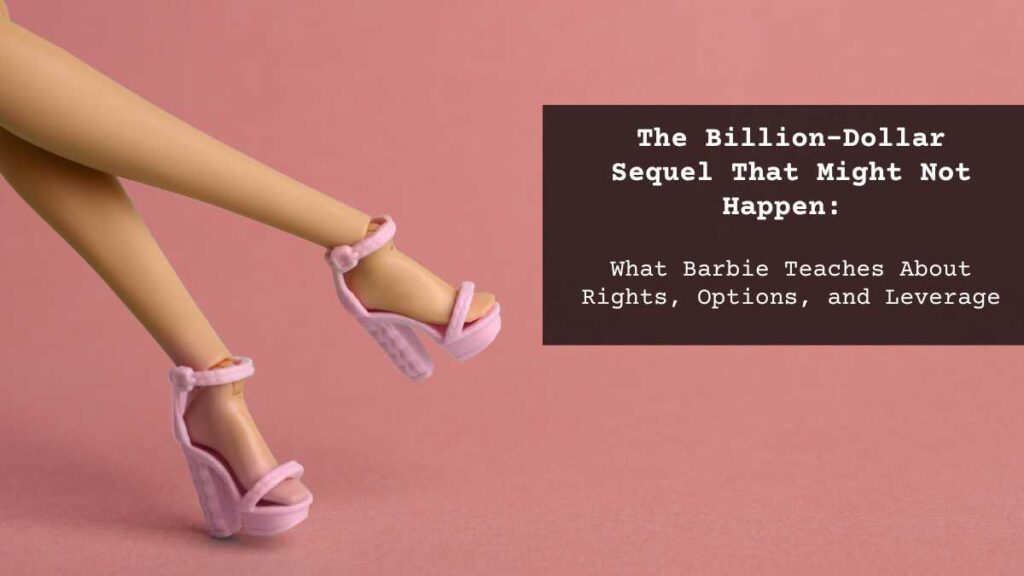

The highest-grossing film in Warner Bros. history might not get a sequel. Not because audiences don’t want one. Because of contracts.
Barbie made roughly $1.4 billion. And according to recent reporting, Barbie 2 is stalled, possibly dead, tangled in rights deadlines and deals that haven’t closed. However it resolves, the situation is one of the clearest real-world lessons in how rights, options, and leverage actually work, and why the time to think about a sequel is before you know whether there will ever be one.
Here’s what’s reportedly going on, and what every filmmaker can take from it. (The specifics below are drawn from press reporting, not confirmed deal documents, so treat them as the shape of the situation rather than the fine print.)

Lesson one: reversion clauses put a clock on your rights
Warner Bros. didn’t own Barbie outright. It licensed the property from Mattel, the toy company that owns the doll. And reporting indicates that if Warner Bros. doesn’t move a sequel into active development by a certain deadline, those rights can revert to Mattel, who could then take the property elsewhere.
That’s a reversion clause, and it’s one of the most important provisions in any rights deal. A reversion says: if you don’t actually use the rights within a defined window, they go back to whoever granted them. It exists to stop a rights-holder from sitting on a property and doing nothing with it.
For a filmmaker, reversion cuts both ways. If you’re licensing material from someone else, a reversion deadline is a clock you have to beat. If you’re the one granting rights to your work, a reversion clause is a protection, a way to get your material back if the other side doesn’t do anything with it. Either way, the lesson is the same: know whether there’s a clock on your rights, know when it runs out, and know what happens when it does.
Lesson two: if you don’t lock the sequel early, you renegotiate from zero
Here’s the part that should stop every producer cold. When Warner Bros. made Barbie, the studio reportedly did not lock its key talent into sequel options. They made the deal for one movie.
That probably didn’t look like a mistake at the time. Nobody knew Barbie would earn well over a billion dollars. But because the sequel wasn’t secured up front, Warner Bros. now reportedly has to renegotiate every deal from scratch, with talent whose value is completely different than it was before the first film became a phenomenon.
This is what a sequel option is for. An option gives the studio or producer the right, but not the obligation, to bring the same people back for another film on pre-agreed terms. You negotiate it in the first deal, when nobody yet knows whether the film will be a hit. Lock it early, and a sequel is a matter of exercising a right you already hold. Skip it, and you’re back at the negotiating table after the leverage has shifted entirely.

Lesson three: leverage moves after the hit, and which way it moves depends on where you sit
This is where it gets genuinely interesting, because the lesson flips depending on which side of the table you’re on.
If you’re the producer or studio, you want to lock sequels, options, and continuing rights before you have a hit. Before the first film comes out, talent has less leverage, and securing future rights is comparatively cheap. After a billion-dollar success, those same rights get dramatically more expensive, if you can get them at all.
But if you’re the writer, director, or talent, the exact opposite may be true. Locking yourself into three films before anyone knows whether the first one works can mean signing away the leverage you would have had after a massive success. Maybe you want to grant an option. Maybe you don’t. Maybe you agree to one, but negotiate a substantial compensation increase that kicks in if it’s exercised, so that if the film becomes a phenomenon, you share in what your value has become.
That’s why these provisions get negotiated so heavily. The producer is trying to protect the franchise before it becomes valuable. The creator is trying to protect the leverage they’ll have if it does. Same clause. Completely different interests.
The takeaway
Barbie is a $1.4 billion example of why you negotiate the sequel before you know whether there will ever be one.
The rights, the options, and the reversion terms that decide whether a franchise lives or dies are set at the very beginning, in the first deal, long before anyone knows what the film will become. By the time you have a hit, the leverage has already moved, and everyone knows exactly what they’re worth. The provisions you didn’t secure the first time are the ones you’ll pay dearly for, or never get, the second time.
So whichever side of the table you’re on, the lesson is the same: the most important sequel decisions are made before the first film is even released. It’s never just the movie. It’s the paper underneath it.