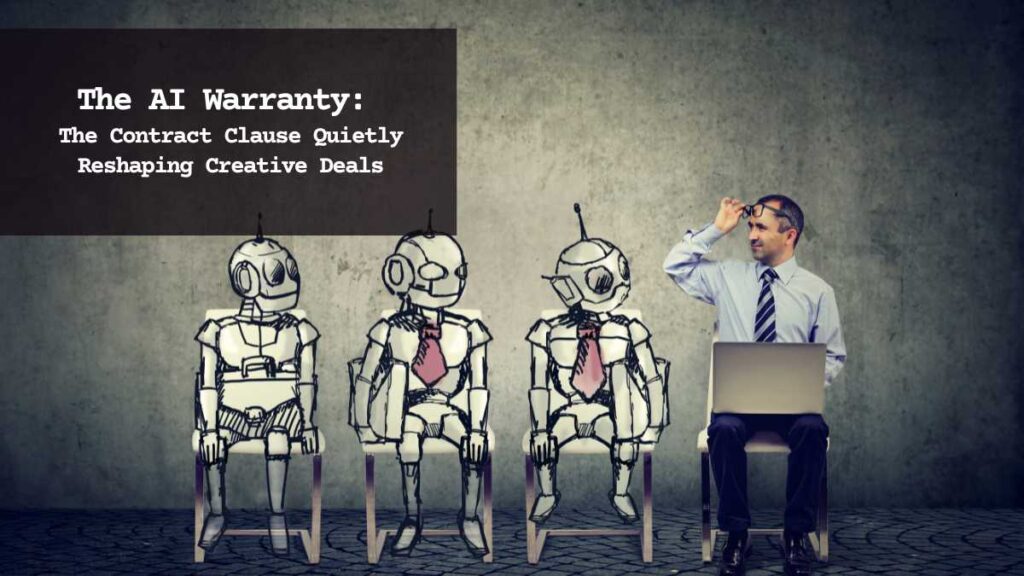

A debut novelist’s reported seven-figure book deal collapsed recently over a single question: was the manuscript written by a human, or by AI? The author denied using it. The deal fell apart anyway. And the clause at the center of that story is now showing up in contracts across publishing, film, and content creation. It’s called an AI warranty, and if you sign creative deals, you need to understand it.
What an AI warranty is
A warranty, in a contract, is a promise you make that something is true, and that you’ll be liable if it isn’t. Creative contracts have always included an “originality warranty”: the creator promises the work is their own original creation and doesn’t infringe anyone else’s rights.
The AI warranty is a newer, more specific version of that promise. It asks the creator to warrant that the work was created by a human, not generated by artificial intelligence, or to disclose exactly how and where AI was used. In publishing, film, and content deals, some version of this language is spreading fast.
There’s a real legal reason behind it. Under current U.S. Copyright Office guidance, copyright protection requires human authorship. Purely AI-generated material, without meaningful human creative control, may not be copyrightable at all. So a buyer acquiring your work has a genuine concern: if a chunk of it was AI-generated, they may not be getting the protectable, ownable asset they’re paying for. The AI warranty is how they try to protect themselves against that.

Why this clause is different from the ones before it
Here’s what makes the AI warranty tricky in a way older warranties aren’t.
When you warrant that your work doesn’t plagiarize someone else’s novel, that’s a fact you can know and control. You know whether you copied someone. But “no AI was used” is becoming harder to prove and easier to be accused of, because of one uncomfortable reality: AI detection tools are unreliable.
Detectors regularly flag human-written work as AI-generated. False positives are common and well-documented. Which creates a genuinely unfair trap: you can warrant, truthfully, that you wrote every word yourself, and a detection tool can still flag your work, and suddenly your truthful warranty isn’t enough, because the other side no longer believes it.
That’s what makes this different. With most warranties, if you tell the truth, you’re protected. With an AI warranty, telling the truth may not save you if a flawed tool says otherwise, and you’re left trying to prove a negative: that you did not use a machine. That’s close to impossible.
What creators should watch for
If you’re signing any creative deal now, a book contract, a screenwriting agreement, a content or ghostwriting deal, read the AI provisions carefully and understand a few things before you sign.
First, know what you’re actually warranting. Is it a flat “no AI was used”? Or a more reasonable “AI was not used to generate the creative expression, though standard tools like spell-check are fine”? The difference is enormous. A blanket no-AI warranty can be breached by using an ordinary grammar tool. A well-drafted clause carves out routine, non-creative assistance.
Second, look at what happens on an accusation. Can the other side terminate the deal on suspicion alone? On a detection tool’s say-so? Or do they have to actually prove AI-generated content? Who bears the risk if a detector is wrong? These are negotiable terms, and they matter enormously, because the whole problem is that suspicion can outrun proof.
Third, consider disclosure. If you did use AI in any capacity, even lightly, the safest path is usually to disclose it up front rather than warrant a flat no and hope it never comes up. Many contracts now allow for disclosed, limited AI use. Silence followed by a later accusation is the worst position to be in.
The bigger issue: who’s protecting you
There’s one more layer worth naming, because the collapsed book deal illustrated it. In that story, the concern was reportedly raised by the author’s own agent.
That’s worth sitting with. An agent works with the same publishers and studios repeatedly, over years. You may be a one-time client on one deal. So when a scandal risk appears, an agent’s incentives and yours don’t automatically point in the same direction. The relationship they protect may not be yours.
This isn’t a claim that agents betray clients. It’s a structural observation: when money and reputation are on both sides of a deal, the person whose only job is protecting you is your own attorney, not the agent brokering the deal, and not the counsel for the party on the other side of the table. In an environment where a single AI accusation can end a career, knowing who is actually in your corner matters more than ever.
The takeaway
The AI warranty is now a standard part of the creative-contract landscape, and it’s not going away. It exists for a real reason, buyers need to know they’re acquiring protectable, human-authored work. But it carries a real trap, because AI detection is unreliable, and a truthful warranty can still be doubted. If you’re signing any creative deal, know exactly what you’re warranting, know what happens if you’re accused, and make sure someone whose only loyalty is to you has read the language before you sign. Because in this new era, your signature on that warranty may be one of the most consequential things in the whole contract.