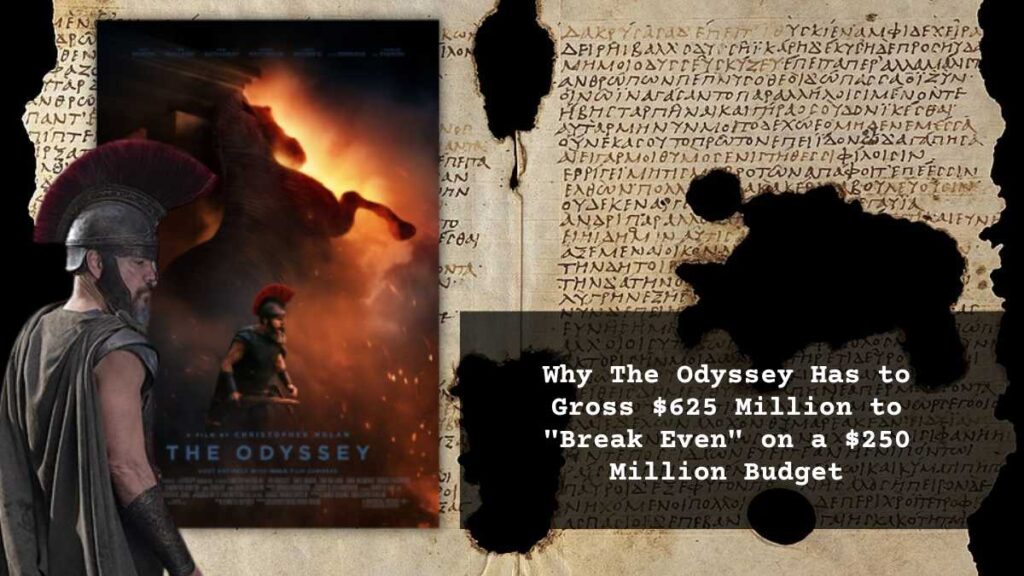

Christopher Nolan’s The Odyssey reportedly cost about $250 million to make. So why do the headlines say it needs to earn around $625 million just to break even?
People assume someone is inflating the number. They aren’t. The gap between those two figures is one of the most useful things a filmmaker can understand about how movies actually make money, and it comes down to a single distinction: box office gross is not the same as studio revenue.
Here’s how the real math works, and why it matters just as much on a $3 million indie as it does on a Nolan blockbuster.

There Are Actually Two Numbers
Start with the budget. That $250 million is the production cost, the money spent to actually make the film. It doesn’t include marketing, and for a global release like this, marketing reportedly adds roughly another $125 million.
So the film’s total cost sits around $375 million. Production plus marketing.
A lot of people stop there and assume $375 million is the break-even point. It isn’t. And the reason is the part almost everyone misses.
The Studio Doesn’t Keep the Box Office
When a movie sells a ticket, the studio does not receive that whole dollar. Movie theaters keep a significant share of every ticket sold. Domestically, the split between studio and exhibitor generally lands somewhere near half over the life of a run. Internationally, local theaters and distributors often keep an even larger portion.
So of every dollar reported at the worldwide box office, only a fraction actually flows back to the studio.
That’s why the break-even line sits so far above the film’s cost. If the studio needs its share of ticket sales to cover roughly $375 million in production and marketing, the film has to gross far more than $375 million for that share to add up. Once you account for the theatrical split, the break-even point for The Odyssey lands somewhere around $625 million in worldwide ticket sales.
That’s the whole gap in one sentence: $375 million is what the film cost. About $625 million is what it has to sell for the studio to get that $375 million back.
Why a Movie Can Gross Hundreds of Millions and Still “Lose”

This is the same reason you’ll see a film earn a headline-grabbing box office number and still get called a financial disappointment. The number in the headline is the gross. The number that reaches the studio is much smaller.
And it goes deeper than the theatrical split. Once a film is in release, the definition of what counts as “revenue” and what gets deducted before anyone sees a profit is entirely a matter of contract. Distribution fees, marketing costs, and financing charges all come out before a film shows a “net profit,” which is why a movie can be a commercial success and still report no net profit at all to the people holding net-profit participation.
If you’ve ever heard that a net profit point can be worth nothing, this is the mechanism behind it. Gross is not revenue, revenue is not profit, and every one of those gaps is defined in the paperwork.
Why This Matters on a $3 Million Indie
You might think this is a big-studio problem. It isn’t. The exact same principle governs an independent film’s financing and backend.
When an investor asks when they’ll recoup, or when a lead actor negotiates a box office bonus, the number that matters is never the headline gross. It’s what actually flows back to the production after the theaters, the sales agents, and the distributor take their share. An indie producer who builds a backend deal or a bonus around “box office” without defining what that means, and without accounting for how little of the gross actually comes home, is making the same mistake the headlines make about The Odyssey, just with smaller numbers and higher personal stakes.
The lesson scales in both directions. Whether it’s a $250 million blockbuster or a $3 million feature, the discipline is the same: know the difference between what a film sells and what the people financing it actually receive.
The Takeaway
Break-even isn’t the budget. It isn’t even the budget plus marketing. It’s the point where the studio’s share of ticket sales, after everyone else takes their cut, finally covers what the film cost to make and sell. That’s why a $250 million movie needs to gross about $625 million, and why the headline box office number is never the number that matters most.
If you’re financing a film at any budget level, the most important thing you can understand is what actually comes back to you, and how it’s defined. For the full breakdown of why break-even is unknowable from the outside and what actually determines it, see our complete guide: Film Break-Even, Honestly.