(Even If the Composer Is Your Friend)
You finally lock picture. The edit works. The emotion lands.
And then someone asks the question most indie filmmakers don’t want to hear:
“Do you have the music rights cleared?”
If the answer is “the composer said it was fine,” or “it’s my friend’s song,” or “we’re just using it for festivals,” your film is not legally protected.
And worse — it may never be sellable.
Music is one of the most common reasons films fail distribution review, not because filmmakers act in bad faith, but because they misunderstand what permission actually means. A Music License & Release is not about trust, credit, or friendship. It’s about legally securing the right to use music in your film — everywhere the film may go.

What a Music License & Release Actually Does
A Music License & Release is the agreement that gives a production the legal right to synchronize music with picture and exploit that music as part of the finished film.
This includes the right to exhibit the film at festivals, distribute it on streaming platforms, license it to broadcasters, sell it internationally, and market it with trailers and promotional materials.
Without a written license, you do not own the right to use the music, even if the composer created it specifically for you. Copyright law does not recognize “they said yes” as a transfer of rights.
A proper Music License & Release answers one core question that distributors and insurers care about:
Does the production have clear, enforceable rights to use this music in all versions of the film, worldwide, for the life of the copyright?
If the answer is unclear, the film stops there.

“But the Music Was Written for the Film…”
This is where many filmmakers get tripped up.
When music is composed specifically for a film, filmmakers often assume they automatically own it. In reality, ownership does not transfer unless the agreement says so.
There are two legally valid ways to secure original music for a film:
- The music is created as a work made for hire, or
- The composer assigns the copyright to the production in writing.
If neither happens, the composer — not the filmmaker — owns the music, even if it was written exclusively for the project.
A Music License & Release can be structured to handle both scenarios:
- licensing existing music, or
- securing original music with work-for-hire and assignment language.
That flexibility is critical for indie films, student projects, and low-budget productions where roles and expectations often overlap.
Why a Composer Agreement Is Not the Same Thing
This is an important distinction.
A Composer Agreement governs the relationship between the filmmaker and the composer — things like deadlines, revisions, fees, credit, and creative expectations.
A Music License & Release governs the rights — what the production can legally do with the music once it exists.
Sometimes you need both. Sometimes the license alone is sufficient. But relying on a composer agreement without a clear license is one of the most common chain-of-title mistakes seen in E&O review.
In other words:
A composer agreement manages the collaboration.
A music license protects the film.
Why “Permission” Isn’t Enough
Even when a composer is fully on board, there are often other rights holders involved, sometimes without the filmmaker realizing it.
These can include:
- co-writers
- publishers
- record labels
- session musicians
- unions or guilds
- performing rights organizations (PROs)
A distributor or insurer doesn’t want assurances — they want warranties. They want written confirmation that all necessary rights have been cleared, and that the licensor will stand behind those representations if a claim arises later.
A proper Music License & Release requires the licensor to confirm:
- they control the rights they’re granting
- the music contains no uncleared samples
- no third-party approvals are required
- the production won’t face surprise royalty or reuse claims
That’s not over-lawyering. That’s how films get delivered.
Why Festivals, Distributors, and E&O Insurance Require This

Errors & Omissions insurance exists to protect distributors from rights claims. Music is one of the highest-risk categories because it’s heavily regulated, frequently shared, and often misunderstood.
If a film lacks written music licenses:
- E&O coverage may be denied
- distribution deals can collapse late in the process
- films can be pulled after release
- takedown demands become real
Even major platforms require producers to prove that music rights are cleared, perpetual, assignable, and worldwide.
A Music License & Release does that work quietly, before it becomes a problem.

What About Soundtracks and Future Success?
Many indie filmmakers worry that broad music rights feel premature — especially on student films or shorts.
But here’s the reality: you don’t get to decide which project succeeds.
Short films get acquired. Student films go viral. Festival films get optioned. And when that happens, the paperwork is examined retroactively.
A well-drafted Music License & Release doesn’t force you to exploit the music in a soundtrack. It simply ensures that if the opportunity arises, the film isn’t blocked by missing rights.
That’s not aggressive. It’s protective.
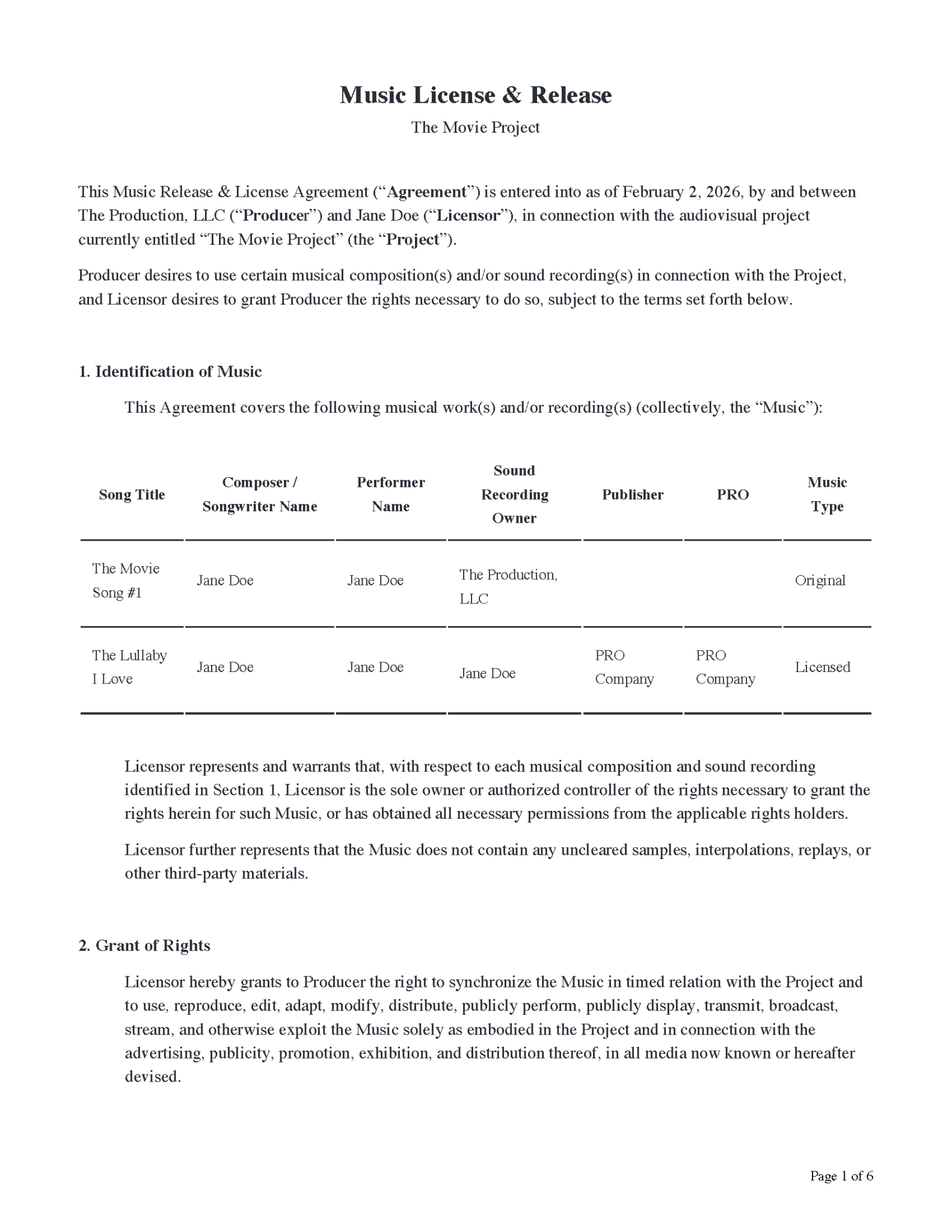
Why Thoolie’s Music License & Release Is Built for Indie Films
Generic music licenses are often written for commercial campaigns or major labels. They don’t work for indie film realities.
Thoolie’s Music Release & License (Indie Standard) was drafted to handle:
- original scores and licensed songs
- paid and unpaid/student scenarios
- PRO disclosures and cue-sheet cooperation
- moral rights waivers required for editing
- distributor and E&O expectations
It’s designed to be clear, flexible, and realistic — without assuming studio budgets or legal teams.
The Quiet Truth About Music Clearance
Most films don’t fail because the music was bad.
They fail because the rights were never locked down.
A Music License & Release isn’t about mistrust. It’s about making sure your film can go where you hope it will go — without stopping at the paperwork.
If you’re serious about finishing your project, submitting to festivals, or selling your film, this is one agreement you shouldn’t skip.
👉 Download the Thoolie Music Release & License (Indie Standard)
Built by entertainment lawyers. Designed for real-world indie productions.
FAQ
Yes. Unless the agreement clearly establishes work-for-hire or assigns the copyright, the composer owns the music.
Yes. A license can be paid or unpaid, but it must still clearly grant the necessary rights.
Most reputable festivals require proof that music rights are cleared, especially if the film advances or is distributed.
Only if the license grants worldwide, perpetual rights and allows assignment to distributors.
Not always. Composer agreements manage the relationship; music licenses secure the rights.