Why Distribution Rights Matter
Finishing your movie isn’t the finish line — it’s the starting line.
Your next challenge? Distribution.
Distribution determines who sees your film, where, and for how long — and it all depends on one thing: your distribution rights.
Understanding indie film distribution rights (and the contracts that govern them) can make or break your career. Whether you’re an indie filmmaker, a student, or a new producer learning the ropes, this guide will help you decode how distribution really works — across theatrical, streaming, international, and digital platforms.
Film distribution isn’t just about selling a movie — it’s a structured legal relationship between the producer and the distributor that determines how the film moves through the marketplace. Every distribution deal involves a combination of rights, windows, territories, and revenue-sharing rules. Understanding these building blocks is what separates a filmmaker who signs a fair, strategic deal from a filmmaker who loses ownership or never sees returns.
What Are Distribution Rights?
Distribution rights are the permissions that allow a distributor, platform, or sales agent to exploit your film commercially.
They define who can show your film, where, for how long, and under what terms.
Distribution rights are sometimes called exploitation rights, because they relate to how your film can be monetized across different platforms. A distribution agreement specifies exactly which exploitation rights a distributor may use — and which ones remain with the producer.
Think of them like slices of a pie:
- Theatrical
- TV / Broadcast
- VOD (Video on Demand)
- SVOD (Subscription Streaming)
- AVOD (Ad-Supported Streaming)
- Home Video
- Educational / Non-Theatrical
- Airline / Military / Institutional
- Digital / Online / Social
Each right can be licensed separately — or bundled into a single “all rights” deal.
Smart producers don’t sell everything at once; they negotiate each window or territory for maximum value.
The Concept of Windowing

“Windowing” refers to the release schedule for your film — when it appears in different formats and on different platforms.
| Window | Example | Typical Term |
| Theatrical | Cinema release | 45–90 days |
| TVOD | iTunes / Amazon rental | 30–60 days after theatrical |
| SVOD | Netflix / Hulu / Max | 6–12 months after TVOD |
| AVOD | Tubi / Pluto / Freevee | 12–18 months post-SVOD |
| Free TV | Local or cable broadcast | 2+ years later |
A good windowing strategy allows a film to recoup multiple times — theatrical, then digital, then broadcast — without killing future sales.
In today’s hybrid market, windowing is more fluid than it used to be. Some distributors compress windows to accelerate streaming revenue, while others expand theatrical windows to qualify for awards. Understanding how windowing interacts with festival runs, presales, and international territories gives you significantly more leverage in negotiations.
🎬 Indie Tip:
If a distributor wants “all rights,” push for non-exclusive or time-limited windows. You can always re-license later.
Territories and Regional Rights
This is where most filmmakers get confused.
Just because your film is “on Netflix” doesn’t mean it’s available everywhere on Netflix.
Each territory (region or country) negotiates its own licensing deal.
Examples:
- Netflix India might license a film for 3 years in South Asia.
- Netflix U.S. might pass entirely.
- Sky UK could hold the broadcast window in the U.K.
- Gravitas Ventures or FilmHub might handle U.S. VOD.
Territorial deals are common in international sales.
Distributors often sell your film region-by-region — each with a different MG (minimum guarantee), marketing plan, and term.
International distribution rights are often the backbone of independent film financing. In many cases, foreign presales — especially in territories like Germany, France, Japan, and the UK — are worth more than the entire U.S. VOD market. Each territory evaluates genre, cast, cultural relevance, and local demand differently, which is why sales agents build territory-by-territory strategies instead of relying on a single global buyer.
🎬 Producer’s Note:
Always know your territory map. Losing track of who owns what can kill future deals.
How Film Distribution Actually Works (In Practice)
Most indie filmmakers assume distribution happens after the movie is finished — but the strongest distribution strategies begin during development. Distributors and sales agents look at the genre, cast, budget level, festival plan, and deliverables before they consider acquisition. A strong distribution plan can attract funding, talent, and partnerships long before the first day of production.
Where Most Films Run Into Trouble
Understanding rights is one thing. Documenting them properly is another.
This is where most indie projects fall apart — not because the film isn’t good, but because the paperwork doesn’t support the deal.
The Role of Sales Agents — And Why You need One Before Production

Many first-time filmmakers assume sales agents only come in after a film is finished.
In reality, a strong sales agent can be one of the first (and most essential) partners on your team — sometimes the reason your movie gets made at all.
What a Sales Agent Actually Does
A sales agent is the bridge between your film and the global marketplace.
They sell your film’s rights territory-by-territory to distributors and platforms worldwide.
Their key functions include:
- Packaging & Positioning: Helping refine your pitch deck, cast attachments, and presale materials to attract buyers.
- Presales: Securing Minimum Guarantee (MG) offers before production from international distributors.
- Market Representation: Showcasing your film at markets like Cannes, AFM, EFM, TIFF, or Berlinale.
- Delivery Management: Coordinating deliverables and marketing assets for buyers once the film is complete.
So… Do You Get the MG Before Production?
Sometimes — but not directly.
Here’s the actual workflow:
- The Sales Agent negotiates presale deals with distributors in various territories (e.g., Germany, France, Japan).
- Those distributors sign contracts promising to pay an MG upon delivery of the completed film.
- The agent bundles those contracts and provides them to a bank or gap financier as collateral.
- The bank loans against those MGs (typically 60–80% of their value), giving you cash flow to shoot.
- Once the film is delivered, the distributors pay the MGs, the bank is repaid, and remaining proceeds flow back through the chain.
In short:
💬 You don’t usually get MG cash upfront — but you can finance production using those presale commitments.
Why “Delivery” Still Matters
MGs are only paid once the film meets delivery standards:
approved format, insurance, M&E tracks, and all union paperwork.
If the film isn’t delivered exactly as contracted, payment can be delayed — or denied.
Many filmmakers underestimate how strict deliverables are. Streamers and foreign buyers have precise technical specifications, and if your film does not meet those standards, the distributor may withhold payment until everything is corrected. That’s why producers budget for deliverables, QC, E&O insurance, captions, M&E tracks, and language files — they’re not optional extras but core components of a distribution agreement.
This is why involving a sales agent early is so valuable:
they align your budget, schedule, and deliverables with what buyers expect.
🎬 Indie Tip: Vet Your Agent
- Look for a track record with films like yours.
- Expect 10–25% commission — higher only if they advance marketing costs.
- Ask for expense caps and territory transparency.
- Avoid lifetime exclusivity; 3–5 years is standard.
A credible agent validates your package, helps secure financing, and keeps your film aligned with market expectations.

⚠️ How Films Lose Their Rights (the “DOGMA” Problem)
Many independent films — including real cases inspired by Dogma — lose control when a private buyer or platform acquires all rights in perpetuity.
Here’s how it happens:
- The producer, desperate for release, signs an “all media, worldwide, in perpetuity” contract.
- The film sells — but the creator never sees a dime.
- Years later, when it gains cult status, they can’t re-release, remaster, or monetize it.
This is the Dogma Trap: you didn’t just sell distribution — you sold your ownership.
Want to learn more about Film Rights & Ownership? Start Here: Who Owns the Rights to a Film? A Guide for Filmmakers and Producers & Film Rights Ownership Checklist: What Every Producer Must Have Before Distribution
✅ Avoid this: Limit your rights grant. Define term, territory, and media formats clearly.
Major Terms to Watch for in Distribution Agreements
| Clause | What It Means | What to Watch For |
| Term | How long the distributor controls your film. | Cap at 7–15 years; avoid “in perpetuity.” |
| Territory | Geographic scope. | Specify countries or regions — not “universe.” |
| Media / Platforms | Where your film can appear. | List approved formats only. |
| Exclusivity | Whether you can license to others. | Push for non-exclusive if possible. |
| Gross vs Net | How revenue is defined. | Demand clear accounting. |
| Marketing & Delivery Costs | Expenses charged to you. | Cap or pre-approve. |
| Audit Rights | Your right to verify reports. | Always include it. |
| Reversion Clause | When rights revert. | Trigger if no release in 12–18 months. |
| Assignment | Can they resell your deal? | Only with written approval. |
Holdbacks: A contractual period where you cannot exploit the film on competing platforms. Holdbacks can dramatically affect revenue if they block important windows.
Cross-collateralization: When revenue from one territory or window is used to cover losses or expenses from another. Avoid letting distributors cross-collateralize without limits.
Reporting Requirements: How often the distributor must send revenue statements. Quarterly reporting is standard — anything less frequent can slow cash flow.
🧾 Sample Clause Decoded
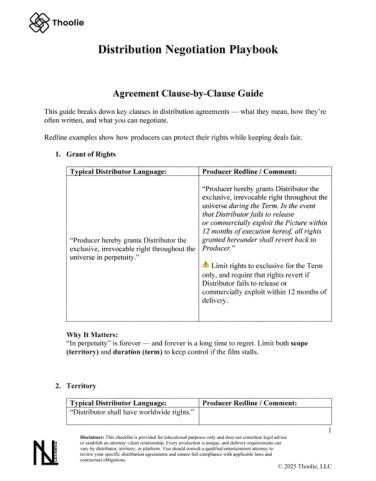
“Distributor shall have the exclusive right to distribute the Picture in all media, throughout the universe, in perpetuity.”
🚨 Translation: You’ve just given away your film forever.
✅ Replace with:
“Distributor is granted exclusive rights for Theatrical, TVOD, and SVOD distribution for a period of ten (10) years, worldwide excluding Asia.”
💡 Real-World Example: When Windowing Goes Wrong
In 2023, a mid-budget European indie sold global streaming rights to a small aggregator, thinking it was a “Netflix deal.”
It turned out to be Netflix India, and the contract barred U.S. and European resale.
Result: 90% of the intended audience lost — and the film’s value vanished.
💬 Lesson: Always confirm territory, platform, and subsidiaries in every agreement.

“So, you may be thinking… there has to be more than that.”
Well, there is.
You’ve learned how distribution works on paper — now learn what it really looks like in contracts.
Inside the Vault, Thoolie Insiders (free members) unlock the full Distribution Negotiation Playbook, including:
- The “Before You Negotiate” glossary that decodes distributor jargon
- Clause-by-clause redline guides showing what to accept, revise, or reject
- Real-world markup samples
- And the Visual Rights Chain Map — every producer’s roadmap before signing anything
You can read it all — for free — when you join as a Vault Insider.
What Distributors Look For Before They Make an Offer
Distributors don’t acquire films randomly — they evaluate specific elements to determine whether a project is marketable. The top factors include:
- Recognizable cast or niche appeal
- Genre trends (horror, thriller, documentary true-crime, etc.)
- Festival momentum (Sundance, TIFF, SXSW, Tribeca, etc.)
- International value (cast + concept + presale viability)
- Strength of your deliverables
- Chain-of-title clarity
- Whether you’ve already over-licensed certain windows
If even one of these elements is unclear, a distributor may walk away — or dramatically reduce the offer.
Before You Enter a Distribution Deal
Most filmmakers don’t think about contracts until a deal is already on the table.
That’s when it gets expensive. Distributors aren’t going to walk you through what your agreement should say — they expect you to already have your rights, ownership, and paperwork in order. If those pieces aren’t clear, you can lose leverage… or lose the deal entirely.
If you’re preparing for distribution, this is the moment to get your agreements in place.
Must Read:
- Before distribution review your complete Film Rights Ownership Checklist →
- What distributors require at delivery → Indie Film Delivery Checklist →
FAQ: Distribution Rights & Agreements
A film distribution agreement is a contract between a producer and a distributor that grants the distributor the right to market, sell, or license the film in specific territories and formats. It defines how revenues are split, who pays marketing costs, and how long the distributor controls the rights.
Distribution rights specify where, how, and for how long a distributor can sell or stream your film. These may include theatrical, streaming (VOD/SVOD/AVOD), television, airline, or educational markets, and are often divided by territory such as North America, Europe, or Asia.
A distribution deal works by granting a distributor the right to sell, license, or exhibit your film in specified territories and formats for a defined period of time. In exchange, the producer receives either a Minimum Guarantee — an upfront advance against future earnings — or a revenue share where income is split as it comes in. The distributor handles marketing, sales, and collection, then deducts their fees and expenses before passing remaining revenue to the producer. Understanding what gets deducted — and in what order — is the most important part of evaluating any distribution deal.
Windowing is the practice of releasing a film across different distribution channels in a deliberate sequence to maximize revenue at each stage. A typical window might start with theatrical release, followed by home video and digital rental, then subscription streaming, then free ad-supported streaming, then television broadcast. Each window is timed to capture audiences willing to pay more for earlier access before moving to lower-cost channels. Windowing rights are often negotiated separately — a distributor handling theatrical rights may not control your streaming window, which is why understanding which windows you’re signing away matters as much as the territory.
Not always — and this is one of the most common misconceptions indie filmmakers have about streaming deals. Netflix, Hulu, and other global platforms license content on a territory-by-territory basis. A deal with Netflix US does not automatically include Netflix UK, Netflix India, or any other regional version of the platform. Each territory is negotiated separately and may involve different license fees, different terms, and different exclusivity periods. When evaluating any streaming offer, always confirm exactly which territories are included in the deal — and which territories remain available for you to license independently through a sales agent or regional distributor.
Selling “all rights” means granting the distributor the right to exploit your film across every format, every territory, and every platform — often in perpetuity. Once signed, you typically lose the ability to re-license the film, negotiate better deals as the film gains value, or reclaim rights if the distributor underperforms. Perpetual “all media, all territory” deals can be particularly damaging because they lock up your film even if the distributor never actively markets it. If an all-rights deal is unavoidable, negotiate hard for a reversion clause — a provision that returns your rights if the distributor fails to release or generate minimum revenue within a defined timeframe.
Yes — and negotiating these is one of the most important things you can do before signing a distribution agreement. Distributors routinely deduct marketing, publicity, delivery, and administrative costs from your revenue share before calculating what you’re owed. Without caps, these deductions can consume your entire backend. Ask for itemized cost approval rights, a cap on deductible expenses, and advance notice before any marketing spend above a threshold is committed. At minimum, ensure the agreement defines which costs are recoupable and which are not — vague language around expenses is one of the most common ways backend revenue disappears.
AbsoluteYes — without exception. Distribution agreements are among the most complex contracts in the film industry, and they are written entirely in the distributor’s favor. A single poorly negotiated clause — around rights scope, recoupment definitions, or reversion triggers — can cost you ownership of your film, eliminate your backend revenue, or lock your film into an exclusive deal with a distributor who never actively sells it. The cost of an entertainment attorney reviewing a distribution agreement is a fraction of what a bad deal costs over the life of the contract. Even if your film is small, the rights you’re signing away have long-term value.
A Minimum Guarantee is an upfront payment from the distributor to the producer, usually recoupable against future earnings. It acts like an advance — offering immediate cash flow but reducing your future backend share until it’s recouped.
In an MG deal, the distributor pays you an upfront amount and recoups that first before you receive additional royalties. In a revenue-share model, you split gross or net revenues as they come in, often without any upfront payment. Hybrid models combine both.
Watch for clauses granting “rights in perpetuity,” unlimited recoupment costs, vague marketing budgets, or missing reversion clauses. Each of these can lock up your film indefinitely or drain your backend revenue.
A reversion clause is a contractual provision that automatically returns your distribution rights if the distributor fails to meet specific performance obligations within a defined period — typically 12 to 24 months. Performance triggers commonly include failing to release the film, failing to generate minimum revenue, or failing to actively market the film in licensed territories. Without a reversion clause, a distributor can legally hold your rights indefinitely even if they never release, market, or generate income from your film. For indie filmmakers, a reversion clause is one of the single most important protections in any distribution agreement — it ensures that inaction or underperformance doesn’t permanently strand your film.
Territories determine where your film can legally be sold or exhibited. Global rights are rarely necessary; many producers keep certain regions (like Asia or LATAM) to sell later through a sales agent or regional distributor.
Comparing distribution offers requires looking beyond the headline Minimum Guarantee number. The most important factors to evaluate side by side are: the territory scope and which windows are included, the recoupment structure and what costs are deductible before you see revenue, the term length and whether rights revert automatically at the end, the presence and strength of reversion clauses, audit rights that allow you to verify accounting statements, and the distributor’s track record with comparable films. A higher MG with aggressive recoupment and no reversion clause is frequently a worse deal than a lower MG with transparent costs and strong reversion triggers. Build a comparison sheet that weights all of these factors equally.
Technically yes — but it carries significant risk. Distribution agreements are drafted by experienced entertainment lawyers working on behalf of distributors who negotiate these contracts constantly. Without equivalent experience, it’s easy to miss problematic clauses around rights scope, recoupment definitions, audit rights, and reversion triggers — the provisions that determine whether you ever see backend revenue. If hiring an entertainment attorney for full contract review isn’t feasible, consider at minimum having a lawyer review the key clauses around rights granted, recoupment, and reversion before signing. The cost of a focused legal review is almost always less than the cost of a bad distribution deal.
Final Takeaway
Distribution isn’t just about getting seen — it’s about getting paid fairly and keeping your rights alive.
Smart producers understand that distribution rights are the backbone of creative control.
Whether you’re negotiating with Netflix, a festival distributor, or a boutique foreign sales company — this guide is your roadmap.
📥 Download: Distribution Rights Decoder (PDF + Checklist)
and start decoding your deal before you sign.