About this guide
This resource covers how film distribution rights actually work — including the parts most filmmakers only learn about after a deal goes wrong. Every fact, case study, and real-world example has been verified for accuracy. This is not a general overview — it is a working reference for filmmakers preparing for distribution conversations.
Why Distribution Rights Matter
Finishing your movie isn’t the finish line — it’s the starting line.
Your next challenge is distribution. And distribution is entirely governed by rights.
Distribution rights determine who sees your film, where, on which platforms, for how long, and how much money flows back to you. Every distribution deal — from a festival acquisition to a Netflix license to a foreign presale — is a rights transaction. Understanding how those rights work is what separates a filmmaker who signs a strategic deal from a filmmaker who loses ownership and never sees a return.
What Are Distribution Rights?
Distribution rights are the permissions that allow a distributor, platform, or sales agent to exploit your film commercially. They define who can show your film, where, for how long, and under what terms.
Distribution rights are sometimes called exploitation rights because they relate to how your film can be monetized across different platforms and formats. A distribution agreement specifies exactly which exploitation rights a distributor may use — and which remain with the producer.
Think of them as slices of a pie — each one can be licensed separately or bundled into a single deal:
- Theatrical
- TV / Broadcast
- VOD — Video on Demand / Rental
- SVOD — Subscription Streaming
- AVOD — Ad-Supported Streaming
- Home Video / Physical Media
- Educational / Non-Theatrical
- Airline / Military / Institutional
- Digital / Online / Social Media
Smart producers don’t sell everything at once. They negotiate each window or territory strategically to maximize value over the life of the film.
The Concept of Windowing

Windowing refers to the release schedule for your film — when it appears in different formats and on different platforms.
| Window | Example | Typical Term |
| Theatrical | Cinema release | 45–90 days |
| TVOD | iTunes / Amazon rental | 30–60 days after theatrical |
| SVOD | Netflix / Hulu / Max | 6–12 months after TVOD |
| AVOD | Tubi / Pluto / Freevee | 12–18 months post-SVOD |
| Free TV | Local or cable broadcast | 2+ years later |
A strong windowing strategy allows a film to generate revenue multiple times — theatrical, then digital rental, then subscription streaming — without killing future licensing opportunities.
Indie Tip
If a distributor wants ‘all rights’ in a single deal, push for non-exclusive windows or time-limited grants. Rights that aren’t tied up can always be re-licensed later.
Territories and Regional Rights — How Rights Are Actually Divided
This is where most filmmakers get confused.
Just because your film is ‘on Netflix’ doesn’t mean it’s available everywhere on Netflix. Each territory — region or country — negotiates its own licensing deal, with its own minimum guarantee, its own term, and its own platform restrictions.
Examples of how territorial licensing actually works:
- Netflix India might license your film for 3 years in South Asia
- Netflix US might pass entirely on the same film
- Sky UK might hold the broadcast window for the United Kingdom
- Gravitas Ventures or FilmHub might handle US VOD
- A French distributor might hold all rights in France — theatrical, broadcast, and streaming
Why France comes up constantly
France has strong cultural protection laws administered by the Centre National du Cinéma (CNC) that govern how foreign films are distributed and monetized in the French market. French distribution rights are frequently handled separately from the rest of Europe — and France is often one of the most valuable individual territory deals for European-style independent films.
International distribution rights are often the backbone of independent film financing. In many cases, foreign presales — particularly in Germany, France, Japan, and the UK — generate more value than the entire US VOD market. Each territory evaluates genre, cast, cultural relevance, and local demand independently.
Producer’s Note
Always know your territory map. Losing track of who controls which territory can kill future deals — including your ability to negotiate with a buyer who wants rights you have already licensed elsewhere.
How Rights Are Structured Before You Walk Into a Festival
Most filmmakers think distribution rights are something you negotiate after the film is done.
They are not. How rights are structured in your production entity before you walk into a festival determines what you can negotiate when buyers come knocking.
The Obsession example — verified facts
When Curry Barker’s horror film Obsession premiered at the 2025 Toronto International Film Festival, three major buyers wanted it: Focus Features, A24, and Neon. All three were in a bidding war. Barker ultimately chose Focus Features — and turned down A24, which many indie filmmakers consider the holy grail of distribution.
Why did he say no to A24?
Because A24 and Neon only distribute in North America. Focus Features has a global distribution apparatus. Barker and his team spent 24 hours in meetings, ending at 1am, before selecting Focus Features. Part of the appeal was its worldwide reach — and that choice was only possible because of how the production rights were structured from the beginning.
- Capstone Pictures held worldwide rights and fully financed the project
- CAA Media Finance co-repped domestic rights with Capstone separately
- Those two things being clearly defined before TIFF gave Barker the flexibility to choose
The lesson: the filmmaker who understands how to structure pre-existing distribution rights before production starts is the filmmaker who can say no to A24 when something better is on the table.
The production documents that govern this
- The LLC Operating Agreement — defines who holds the rights and in what capacity
- The Investor Agreement — defines what rights investors hold and what revenue they participate in
Sales Agents, Representatives, and Distributors — Who Does What
Most filmmakers use these terms interchangeably. They are not the same thing — and confusing them can cost you in negotiations.
Sales Agent
A sales agent sells your film’s rights territory-by-territory to distributors and platforms worldwide. They do not distribute the film themselves. Their job is to find buyers. They earn a commission — typically 10–25% of the deals they close — and may charge back marketing and market expenses.
In the Obsession deal, Capstone Pictures acted as a rights holder and sales representative. CAA Media Finance co-repped domestic rights separately. These are representation roles — not distribution.
Distributor
A distributor licenses rights from you (or from a sales agent on your behalf) and takes responsibility for releasing the film in their territory. They handle marketing, theatrical booking, platform delivery, and revenue collection in their specific market.
Focus Features is a distributor. Universal Pictures International handled international distribution for Obsession. They are distinct entities with distinct territory responsibilities.
Aggregator
An aggregator is a third-party service that delivers your film to digital platforms — iTunes, Amazon, Tubi, etc. — on your behalf. They are not distributors in the traditional sense. They charge a fee or take a percentage, and they may or may not hold exclusive rights to your film on those platforms.
⚠️ The Distribber Warning
Distribber was a widely used, well-reviewed aggregator that had delivered films to iTunes, Netflix, and Amazon for hundreds of independent filmmakers. In mid-2019, it stopped responding to emails. Films disappeared from platforms without explanation. Revenue payments stopped. The company eventually filed for dissolution, leaving filmmakers with unclear rights and no recourse. Most had signed more than they realized. Read your aggregator agreement the way a lawyer reads a contract — not the way most people read terms of service.
Representative / Co-Rep
A representative — like an agency or entertainment law firm — may co-represent a film’s rights alongside a sales agent. CAA’s role in the Obsession deal was as co-representative alongside Capstone for domestic rights. Representation is a service relationship — not a rights-holding relationship.
How Film Distribution Actually Works (In Practice)
Most indie filmmakers assume distribution happens after the movie is finished. The strongest distribution strategies begin during development.
Development / Pre-Production
- Sales agent attached — ideally
- Territory-by-territory presale strategy built
- MG commitments begin to be negotiated with foreign distributors
- Production entity structured to hold rights clearly
Production
- MG commitment letters used as collateral for production financing
- Bank or gap financier lends against presale commitments — typically 60–80% of value
- Film is made within the delivery specifications required by presale buyers
Post-Production / Festival
- Film completed and delivered to festival
- Buyers evaluate at festival screening
- Bidding or negotiation begins
- Acquisition deal closes
Distribution
- Net proceeds flow to producer and profit participants
- Distributor releases film in their territory
- Revenue flows through agreed waterfall
- Sales agent commissions deducted
- Bank repaid from MG payments upon delivery
Where Most Films Run Into Trouble
Understanding rights is one thing. Documenting them properly is another.
This is where most indie projects fall apart — not because the film isn’t good, but because the paperwork doesn’t support the deal.
The MG Workflow — Do You Get Paid Before Production?
Sometimes — but not directly.
- Sales agent negotiates presale deals with distributors in specific territories
- Those distributors sign contracts promising to pay an MG upon delivery
- Agent bundles contracts and presents to a bank or gap financier as collateral
- Bank loans against those MGs — typically 60–80% of their face value
- Once the film is delivered and accepted, distributors pay the MGs
- Bank is repaid first
- Remaining proceeds flow through the agreed waterfall to producers and participants
Key point
You don’t usually receive MG cash directly before production. You use the MG commitments to secure a loan that funds production. MGs are only paid once the film meets delivery requirements — E&O insurance, M&E tracks, music licenses, subtitle files, and all contractual paperwork.
Recouping Against Domestic vs International — The Most Important Phrase in Your Deal

This is the clause that most indie filmmakers don’t understand until it’s too late.
When a distributor says they will ‘recoup against domestic‘ — they mean their costs are recovered specifically from domestic revenue before you see any backend money from domestic receipts.
When a distributor says they will ‘recoup against worldwide’ — they are pooling revenue from every market they control and recovering costs from the combined pool.
A worked example
Your film generates $500,000 from US theatrical and digital, and $200,000 from international territories. The distributor has $400,000 in recoupable costs.
| Recoup Against Domestic | Recoup Against Worldwide | |
| US domestic revenue | $500,000 | $500,000 |
| International revenue | $200,000 — separate | $200,000 — pooled |
| Recoupment deducted from | Domestic only | Combined pool |
| Recoupment amount | $400,000 | $400,000 |
| Domestic net to producer | $100,000 | — |
| International net to producer | $200,000 — untouched | — |
| Total to producer | $300,000 | $300,000 |
⚠️ Critical red flag
If a distributor controls only domestic rights but tries to ‘recoup against worldwide’ — they are attempting to offset domestic losses against revenue streams they don’t control. Do not agree to this. Cross-collateralization of separate territory deals is one of the primary mechanisms by which backend revenue disappears.
Territory Carve-Outs — What They Are and Why They Matter
A territory carve-out is a specific market or region that is excluded from a distribution deal — either because rights have already been sold there, or because you are strategically holding that territory back.
The Obsession deal illustrates this clearly. Focus Features acquired worldwide rights to Obsession — but specifically excluded France, New Zealand, and Russia, where pre-existing arrangements were already in place. Universal Pictures International handles international distribution in the territories Focus covers.
Why carve-outs happen
- Strategic hold-backs — Japan, South Korea, Germany, or France may be worth more to a regional specialist than to a global buyer
- Pre-existing presales — territories already sold during production financing are carved out automatically
- Cultural protection laws — France’s CNC regulations frequently require a French distributor
- Leverage — holding back territories gives you something to sell after domestic performance proves the film’s commercial value
What filmmakers get wrong
They assume ‘worldwide’ means everywhere. It almost never does. The Monkey Man Netflix deal excluded Spain, Latin America, Iceland, former Yugoslavia, Poland, Russia, the Baltic States, Hong Kong, Indonesia, and pan-Asian PTV and China — because pre-existing deals already covered those markets. A ‘worldwide’ deal simply means the buyer gets everything that isn’t already committed. Always ask: which territories does this deal actually cover? Which are excluded? Who holds those excluded territories?
Split Rights Deals — When Domestic and International Go to Different Buyers
A split rights deal occurs when domestic distribution rights and international distribution rights go to separate buyers — each with their own deal, their own MG, their own marketing obligations, and their own revenue stream.
Split rights deals are common at festivals. A24 and Neon only distribute in North America. If a film sells to A24 at Sundance, international rights may go to a separate sales agent or international distributor. The Talk to Me acquisition at Sundance was structured this way: A24 paid a high-seven-figure sum for North American rights only.
What split rights deals require
- Cross-collateralization prohibition — explicitly prohibit one distributor from offsetting losses against the other’s territory revenue
- Marketing coordination — who controls the release date when domestic and international distributors want different windows?
- Recoupment isolation — each distributor’s recoupment must apply only to revenue from their territory
- CAMA administration — a neutral third-party collection agent ensures each party receives their correct share

⚠️The Dogma Problem — How Films Get Locked Up
Kevin Smith’s 1999 film Dogma is one of the most instructive rights stories in independent film history — and it is not the story most people assume it is.
What actually happened — verified facts
Miramax was owned by Disney in 1999. Dogma faced significant religious controversy, and Disney — uncomfortable with the subject matter — wanted the film out of their portfolio. Harvey and Bob Weinstein personally bought the film away from Miramax using their own funds to shield Disney from the controversy.
Lionsgate Films acquired domestic theatrical distribution rights. Miramax International retained foreign distribution. Sony handled home video. The film was released and performed well — eventually becoming one of Smith’s most acclaimed films.
Then the rights fragmented.
Theatrical and home video rights lapsed. The Weinsteins personally owned the underlying film but had no incentive to actively exploit it. Smith had no recourse. For years Dogma was unavailable to rent, stream, or purchase in any format — a film with a genuine audience, locked because one person held ownership rights and chose not to exercise them.
Smith attempted to buy the rights back — reportedly offering $1 million with assistance from Ben Affleck and Matt Damon — and was turned down. Only after Weinstein’s circumstances changed were the rights eventually released, allowing Dogma to return to theaters and home media in 2024 and 2025.
The real lessons
- Understand who holds underlying ownership vs who holds distribution rights — these are different things
- Reversion clauses need specific, objective triggers — not vague ‘failure to exploit’ language
- Rights fragmentation across multiple parties creates situations where no single party has both authority and incentive to exploit the film
- Minimize fragmentation where possible — and ensure agreements coordinate across all rights holders
What to do instead
Include reversion clauses tied to specific, objective exploitation triggers. Define what ‘active exploitation’ means in writing. Require notice before any ownership transfer. Limit ‘in perpetuity’ grants where possible — or tie them to ongoing active exploitation obligations.
Major Terms to Watch for in Distribution Agreements
| Clause | What It Means | What to Watch For |
| Term | How long the distributor controls your film | Cap at 7–15 years; avoid ‘in perpetuity’ without exploitation obligations |
| Territory | Geographic scope of the deal | Specify countries — ‘worldwide’ must list carve-outs explicitly |
| Media / Platforms | Which formats are licensed | List approved formats only; beware ‘all media now known or hereafter devised’ |
| Exclusivity | Whether you can license to others simultaneously | Push for non-exclusive or time-limited exclusivity |
| Gross vs Net | How revenue is defined before your share is calculated | Demand clear definitions — ‘net’ can be engineered to near-zero |
| Marketing & Delivery Costs | Expenses charged against your revenue share | Cap amounts; require pre-approval above a threshold |
| Recoupment Pool | Which revenue the distributor recovers costs from | Confirm it applies only to territories the distributor controls |
| Audit Rights | Your right to verify revenue statements | Always include; specify frequency and independent accountant rights |
| Reversion Clause | When rights return if distributor underperforms | Trigger if no release in 12–18 months or no revenue for 24 months |
| Assignment | Whether distributor can sell your deal to a third party | Only with prior written approval |
| Cross-Collateralization | Using revenue from one territory to cover losses in another | Prohibit or strictly limit — this is how backend disappears |
| Holdbacks | Contractual period blocking competing platform use | Confirm holdback windows match your windowing strategy |
| Reporting Requirements | How often the distributor sends revenue statements | Quarterly is standard; monthly for active releases |
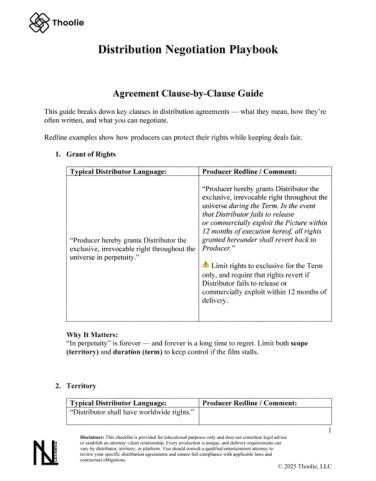
🧾 Sample Clause Decoded
🚨 Original clause:
“Distributor shall have the exclusive right to distribute the Picture in all media, throughout the universe, in perpetuity.”
Translation: You have given away your film permanently, in every format that exists or will ever exist, everywhere, with no end date and no exploitation obligation.
✅ Replace with:
“Distributor is granted exclusive rights for Theatrical, TVOD, and SVOD distribution for a period of ten (10) years in the United States and Canada, excluding all other territories. All rights revert automatically to Producer if Distributor fails to commercially release the Picture within eighteen (18) months of the execution of this Agreement.”
💡 Real-World Example: The Territory Confusion Mistake
This scenario plays out regularly in the independent film market — and is worth understanding before you sign anything.
A filmmaker sells streaming rights to a small aggregator — thinking it is a deal with a major global platform. The aggregator is technically a licensed delivery partner for the platform in one specific region. The contract grants ‘exclusive streaming rights’ to the aggregator for the platform in that territory. The filmmaker assumes ‘exclusive streaming rights on [platform name]’ means global.
It means the one territory the aggregator covers. Because the grant is exclusive, the filmmaker cannot license the film to the same platform in other territories — or to competing platforms — for the duration of the agreement. The rights are tied up. The intended audience in major markets cannot access the film.
The lesson
This is not a hypothetical edge case. It is the reason experienced producers insist on territory-specific language in every streaming agreement. Always confirm: which platform, which territory, which subsidiary, and which competing platforms are restricted by any exclusivity provision.

“So, you may be thinking… there has to be more than that.”
Well, there is.
You’ve learned how distribution works on paper — now learn what it really looks like in contracts.
Inside the Vault, Thoolie Insiders (free members) unlock the full Distribution Negotiation Playbook, including:
- The “Before You Negotiate” glossary that decodes distributor jargon
- Clause-by-clause redline guides showing what to accept, revise, or reject
- Real-world markup samples
- And the Visual Rights Chain Map — every producer’s roadmap before signing anything
You can read it all — for free — when you join as a Vault Insider.
What Distributors Look For Before They Make an Offer
Distributors do not acquire films randomly. They evaluate specific factors to determine whether a project is commercially viable in their market.
- Genre trends — horror, thriller, true crime documentary, and elevated genre consistently outperform in independent distribution markets
- Recognizable cast or niche audience appeal — either name talent or a demonstrated existing audience
- Festival momentum — Sundance, TIFF, SXSW, Tribeca, and Cannes provide third-party validation that accelerates distribution conversations
- International value — cast, concept, and presale viability in foreign markets
- Chain-of-title clarity — distributors conduct chain-of-title review before closing any acquisition; gaps slow or kill deals
- Deliverables readiness — whether your film can meet technical delivery specifications immediately
- Rights availability — whether key windows and territories are still available or already committed
Chain-of-title clarity and deliverables readiness are the two factors most directly within the filmmaker’s control — and the two most commonly overlooked during production.
Before You Enter a Distribution Deal
Most filmmakers do not think seriously about distribution agreements until a deal is already on the table. That is when it gets expensive.
Distributors are not going to walk you through what your agreement should say. They expect you to arrive with your rights, ownership, and paperwork already in order. If those pieces are unclear, you lose leverage — or you lose the deal.
Before any distribution conversation:
- Review your complete Film Rights Ownership Checklist
- Confirm chain-of-title documentation is complete — screenplay assignment or license, work-for-hire agreements, performer releases, music licenses
- Confirm your production entity is correctly structured to hold and transfer rights
- Know your territory map — what is available, what is already committed
- Know your waterfall — what investors, deferred participants, and profit participants are entitled to before you see net proceeds
- Have an entertainment attorney review any agreement before you sign
Final Takeaway
Distribution is not just about getting seen — it is about getting paid fairly and keeping your rights alive for the life of your film.
The Obsession story illustrates what is possible when rights are structured correctly before production starts. The Dogma story illustrates what happens when rights fragment, ownership is unclear, and reversion mechanisms are inadequate.
Neither outcome is about luck. Both are about decisions made — or not made — in the documents that govern your film from day one.
📥 Download: Distribution Rights Decoder (PDF + Checklist) and start decoding your deal before you sign.
Before You Enter a Distribution Deal
Most filmmakers don’t think about contracts until a deal is already on the table.
That’s when it gets expensive. Distributors aren’t going to walk you through what your agreement should say — they expect you to already have your rights, ownership, and paperwork in order. If those pieces aren’t clear, you can lose leverage… or lose the deal entirely.
If you’re preparing for distribution, this is the moment to get your agreements in place.
FAQ: Distribution Rights & Agreements
A film distribution agreement is a contract between a producer and a distributor that grants the distributor the right to market, sell, or license the film in specific territories and formats. It defines how revenues are split, who pays marketing costs, and how long the distributor controls the rights.
Distribution rights specify where, how, and for how long a distributor can sell or stream your film. These may include theatrical, streaming (VOD/SVOD/AVOD), television, airline, or educational markets, and are often divided by territory such as North America, Europe, or Asia.
A distribution deal works by granting a distributor the right to sell, license, or exhibit your film in specified territories and formats for a defined period of time. In exchange, the producer receives either a Minimum Guarantee — an upfront advance against future earnings — or a revenue share where income is split as it comes in. The distributor handles marketing, sales, and collection, then deducts their fees and expenses before passing remaining revenue to the producer. Understanding what gets deducted — and in what order — is the most important part of evaluating any distribution deal.
Windowing is the practice of releasing a film across different distribution channels in a deliberate sequence to maximize revenue at each stage. A typical window might start with theatrical release, followed by home video and digital rental, then subscription streaming, then free ad-supported streaming, then television broadcast. Each window is timed to capture audiences willing to pay more for earlier access before moving to lower-cost channels. Windowing rights are often negotiated separately — a distributor handling theatrical rights may not control your streaming window, which is why understanding which windows you’re signing away matters as much as the territory.
Not always — and this is one of the most common misconceptions indie filmmakers have about streaming deals. Netflix, Hulu, and other global platforms license content on a territory-by-territory basis. A deal with Netflix US does not automatically include Netflix UK, Netflix India, or any other regional version of the platform. Each territory is negotiated separately and may involve different license fees, different terms, and different exclusivity periods. When evaluating any streaming offer, always confirm exactly which territories are included in the deal — and which territories remain available for you to license independently through a sales agent or regional distributor.
Selling “all rights” means granting the distributor the right to exploit your film across every format, every territory, and every platform — often in perpetuity. Once signed, you typically lose the ability to re-license the film, negotiate better deals as the film gains value, or reclaim rights if the distributor underperforms. Perpetual “all media, all territory” deals can be particularly damaging because they lock up your film even if the distributor never actively markets it. If an all-rights deal is unavoidable, negotiate hard for a reversion clause — a provision that returns your rights if the distributor fails to release or generate minimum revenue within a defined timeframe.
Yes — and negotiating these is one of the most important things you can do before signing a distribution agreement. Distributors routinely deduct marketing, publicity, delivery, and administrative costs from your revenue share before calculating what you’re owed. Without caps, these deductions can consume your entire backend. Ask for itemized cost approval rights, a cap on deductible expenses, and advance notice before any marketing spend above a threshold is committed. At minimum, ensure the agreement defines which costs are recoupable and which are not — vague language around expenses is one of the most common ways backend revenue disappears.
AbsoluteYes — without exception. Distribution agreements are among the most complex contracts in the film industry, and they are written entirely in the distributor’s favor. A single poorly negotiated clause — around rights scope, recoupment definitions, or reversion triggers — can cost you ownership of your film, eliminate your backend revenue, or lock your film into an exclusive deal with a distributor who never actively sells it. The cost of an entertainment attorney reviewing a distribution agreement is a fraction of what a bad deal costs over the life of the contract. Even if your film is small, the rights you’re signing away have long-term value.
A Minimum Guarantee is an upfront payment from the distributor to the producer, usually recoupable against future earnings. It acts like an advance — offering immediate cash flow but reducing your future backend share until it’s recouped.
In an MG deal, the distributor pays you an upfront amount and recoups that first before you receive additional royalties. In a revenue-share model, you split gross or net revenues as they come in, often without any upfront payment. Hybrid models combine both.
Watch for clauses granting “rights in perpetuity,” unlimited recoupment costs, vague marketing budgets, or missing reversion clauses. Each of these can lock up your film indefinitely or drain your backend revenue.
A reversion clause is a contractual provision that automatically returns your distribution rights if the distributor fails to meet specific performance obligations within a defined period — typically 12 to 24 months. Performance triggers commonly include failing to release the film, failing to generate minimum revenue, or failing to actively market the film in licensed territories. Without a reversion clause, a distributor can legally hold your rights indefinitely even if they never release, market, or generate income from your film. For indie filmmakers, a reversion clause is one of the single most important protections in any distribution agreement — it ensures that inaction or underperformance doesn’t permanently strand your film.
Territories determine where your film can legally be sold or exhibited. Global rights are rarely necessary; many producers keep certain regions (like Asia or LATAM) to sell later through a sales agent or regional distributor.
Comparing distribution offers requires looking beyond the headline Minimum Guarantee number. The most important factors to evaluate side by side are: the territory scope and which windows are included, the recoupment structure and what costs are deductible before you see revenue, the term length and whether rights revert automatically at the end, the presence and strength of reversion clauses, audit rights that allow you to verify accounting statements, and the distributor’s track record with comparable films. A higher MG with aggressive recoupment and no reversion clause is frequently a worse deal than a lower MG with transparent costs and strong reversion triggers. Build a comparison sheet that weights all of these factors equally.
Technically yes — but it carries significant risk. Distribution agreements are drafted by experienced entertainment lawyers working on behalf of distributors who negotiate these contracts constantly. Without equivalent experience, it’s easy to miss problematic clauses around rights scope, recoupment definitions, audit rights, and reversion triggers — the provisions that determine whether you ever see backend revenue. If hiring an entertainment attorney for full contract review isn’t feasible, consider at minimum having a lawyer review the key clauses around rights granted, recoupment, and reversion before signing. The cost of a focused legal review is almost always less than the cost of a bad distribution deal.