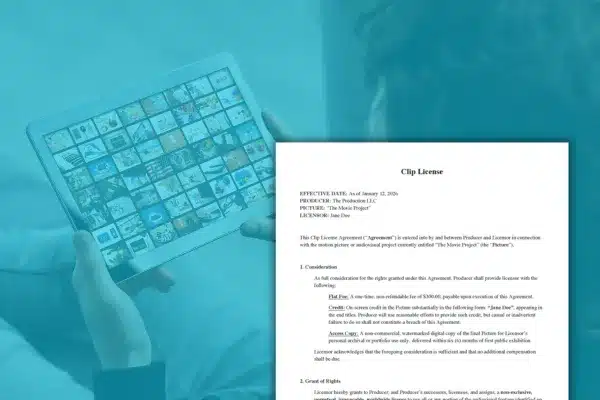

This Clip License Agreement allows filmmakers and producers to legally incorporate existing audiovisual footage into a new motion picture or media project — without transferring ownership of the underlying copyright.
Unlike a work-for-hire or assignment agreement, a clip license grants permission to use specific footage under clearly defined terms. This includes how the footage may be edited, where it can be distributed, how long it may be used, and what consideration is provided to the licensor.
This agreement is drafted to meet the expectations of:
- film festivals
- distributors and sales agents
- streaming platforms
- broadcasters
- Errors & Omissions (E&O) insurers
Whether you’re licensing archival footage for a documentary, clearing news clips, using personal footage from an archive, or negotiating a credit-only license, this agreement provides the paper trail required for clean chain of title.
What Is a Clip License Agreement?
A Clip License Agreement is a legal contract that grants a producer the right to use a specific portion of pre-existing footage in a new project.
The licensor retains ownership of the footage.
The producer receives a non-exclusive license to use the footage under agreed-upon terms.
This structure is standard in documentary filmmaking, historical projects, and narrative films that incorporate third-party material.
Clip Licensing vs. Fair Use (What Filmmakers Get Wrong)
Many filmmakers assume short clips fall under “fair use.” In reality, fair use is narrow, fact-specific, and frequently misapplied, especially in commercial distribution.
Even when fair use might apply, festivals, distributors, and insurers often still require written licenses to reduce risk.
If your film includes:
- archival footage
- news clips
- footage sourced from another film or show
- home videos or personal footage you don’t own
…a Clip License Agreement is typically required to avoid delivery issues later.
This agreement is designed for filmmakers who want certainty, not legal arguments, when releasing their work.
Why This Agreement Matters for Distribution & Insurance
Distributors and E&O insurers review clip licenses to confirm that:
- the licensor had authority to grant rights
- the scope of use matches the film’s distribution plans
- no injunction rights exist that could block release
- proper representations and indemnities are in place
This Clip License Agreement includes the rights language, warranties, indemnification, and no-injunctive-relief provisions commonly required during legal delivery.
FAQ
A Clip License Agreement is a contract that grants permission to use specific film, video, or multimedia clips in a new project, outlining the scope of rights, duration, and permitted media.
Typically the rights holder (licensor) and the producer, production company, or filmmaker seeking to use the clip (licensee).
No. It only grants limited use rights for the licensed clip. The copyright owner retains all other rights.
Yes. Documentaries commonly rely on archival and third-party footage, which typically requires written licenses for distribution.
Yes. The agreement includes flexible consideration structures commonly used in indie filmmaking.
Yes. The agreement is drafted to meet standard chain-of-title and E&O insurance expectations.
Yes. The licensed footage and maximum duration are clearly defined in the attached exhibit.