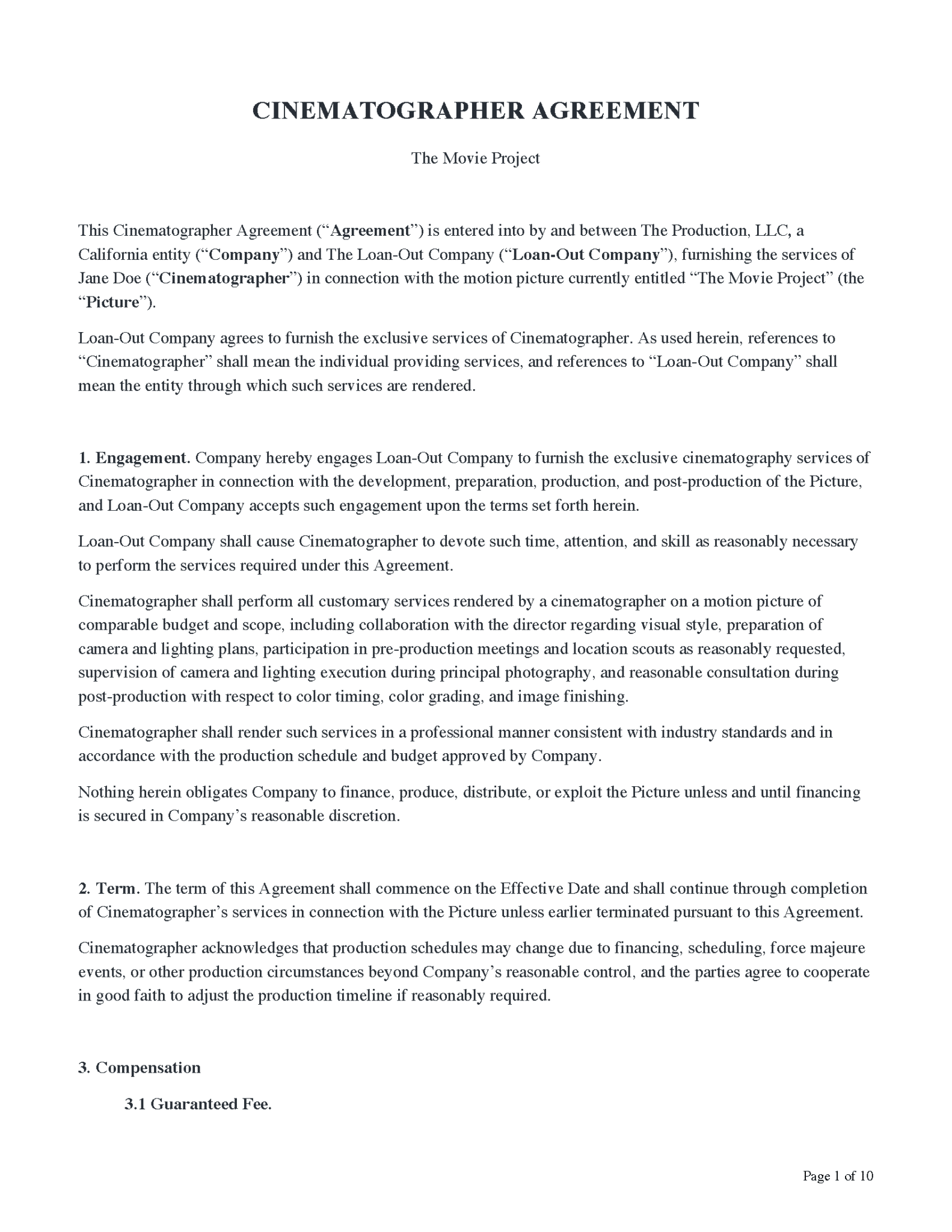
The Cinematographer Agreement (Non-Union) is an attorney-drafted production agreement designed specifically for independent filmmakers.
It establishes the terms under which a cinematographer performs services on a film, including responsibilities during pre-production, principal photography, and post-production. It also documents compensation structures commonly used in independent film, such as guaranteed fees, deferred compensation, bonuses, and optional backend participation.
Most importantly, the agreement ensures that all footage and visual materials created during production are owned by the production company as work-made-for-hire, with assignment provisions that protect the film’s chain of title.
Distributors, insurers, and sales agents routinely review agreements with key creative personnel before accepting a film for distribution. Having a properly structured cinematographer agreement helps ensure the film’s ownership rights are clear and legally enforceable.
This template is designed to meet those expectations while remaining practical for independent productions.
What Is a Cinematographer Agreement?
A Cinematographer Agreement is the contract between a production company and the Director of Photography that defines how the cinematographer will participate in the production of the film.
It typically covers:
The scope of the cinematographer’s services
Compensation and payment structure
Credit and billing language
Ownership of footage and visual materials
Creative collaboration with the director
Insurance and delivery obligations required for distribution
Because the cinematographer is responsible for capturing the film’s images, their work becomes part of the film’s copyright and chain of title.
Without an agreement assigning those rights to the production company, distributors and insurers may refuse to accept the film.
Why Independent Films Need This
Many independent productions begin with informal collaborations between directors, producers, and cinematographers. While that approach may work during early development, it can create serious legal problems once the film is completed.
Distributors and streaming platforms expect production companies to prove they legally own every creative contribution that appears in the finished film. This includes the directing services, performances, music, and cinematography.
A written cinematographer agreement ensures that the production company owns the footage and that the cinematographer’s services are properly documented for delivery requirements.
It also prevents common disputes over compensation, credit, and use of production materials.
Hiring a DP for your film?
Thoolie’s Cinematographer Agreement covers footage ownership, work-for-hire, deferred compensation, loan-outs, and chain-of-title documentation distributors actually check. Attorney-drafted for indie productions. $39.99. Instant download
How This Agreement Is Structured
The Cinematographer Agreement is designed to support the types of compensation and production structures commonly used in independent film.
Filmmakers can customize the agreement through a guided questionnaire that determines how the contract is generated.
The agreement can accommodate:
Guaranteed fees paid during production
Deferred compensation payable from film revenues
Optional backend profit participation
Performance bonuses tied to distribution or box-office milestones
Loan-out company engagements
Equipment or camera package rental arrangements
Because each project is different, the agreement allows these elements to be included only when applicable, ensuring the final contract reflects the actual deal between the parties.
Chain of Title and Ownership Protection
One of the most important purposes of a cinematographer agreement is protecting the film’s chain of title.
The cinematographer’s services are treated as work made for hire, meaning the production company owns the footage and visual materials created during production.
The agreement also includes assignment language to ensure ownership is transferred to the production company even if the work-for-hire doctrine does not apply under certain copyright laws.
This protection is critical when delivering a film to distributors, insurers, or sales agents, all of whom expect clear ownership of the film’s visual elements.
Loan-Out Companies
Many cinematographers work through loan-out companies for tax and business reasons.
The agreement allows the production company to contract directly with the loan-out company while still ensuring that the individual cinematographer is responsible for performing the services required by the production.
This structure helps preserve the cinematographer’s business arrangements while protecting the production company’s rights in the film.
What This Agreement Is Not
This agreement is designed for non-union productions.
It does not replace guild agreements required when a production becomes signatory to organizations such as IATSE or other cinematography unions.
However, the agreement includes language allowing the production to conform to union requirements if the project later becomes a signatory production.
Common Mistakes This Agreement Helps Avoid
Independent productions often run into legal issues because cinematography arrangements are handled informally.
Common problems include disputes over ownership of footage, confusion about deferred compensation, and disagreements over credit placement once the film is released.
This agreement helps avoid those issues by documenting the expectations of both the production company and the cinematographer before production begins.
Clear agreements protect relationships and make it easier for the film to move forward into distribution.
Create Your Cinematographer Agreement
Generate a customized cinematographer agreement in minutes using Thoolie’s guided questionnaire.
Your answers determine the compensation structure, credit language, and ownership provisions included in the final contract so the document reflects the real deal between the parties.
Create your document instantly and download a production-ready agreement designed for independent filmmaking.
Related Resources
FAQs
Yes. A cinematographer captures the actual visual images that become part of the finished film. Without a written agreement assigning those rights to the production company, ownership of the footage can become legally unclear, which may create problems with distributors, insurers, or investors reviewing the film’s chain of title.
In most film productions, the production company owns the footage as a work made for hire. A cinematographer agreement confirms that the images, recordings, and visual materials created during production belong to the production company and may be used in the finished film and its distribution.
Yes. On independent films, cinematographers sometimes receive backend participation or deferred compensation when production budgets are limited. The agreement can define whether the cinematographer receives a guaranteed fee, deferred payment, profit participation, or a combination of these structures.
Many cinematographers provide services through a loan-out company for tax or business reasons. In that situation, the agreement is typically signed with the loan-out entity while the individual cinematographer agrees to personally perform the services required by the production.
Distributors and E&O insurers typically expect written agreements with key creative personnel confirming ownership of their contributions to the film. A properly drafted cinematographer agreement helps demonstrate that the production company owns the footage and has the legal authority to distribute the finished film.
A cinematographer agreement typically includes the scope of the cinematographer’s services, compensation structure, credit, ownership of footage, and delivery obligations. It also addresses issues such as deferred compensation, profit participation, loan-out companies, and cooperation with insurance and distribution requirements.
The terms cinematographer and Director of Photography (DP) are often used interchangeably in film production. Both refer to the person responsible for designing and capturing the visual look of the film, including camera operation, lighting style, and image composition in collaboration with the director.
In most film productions, cinematography services are treated as work made for hire, meaning the production company owns the footage and visual materials created during the project. A written cinematographer agreement confirms this ownership and protects the film’s chain of title for distribution.