
Bloomberg reported last week that YouTube is offering some of its biggest creators millions of dollars to keep their content exclusive to the platform for a period of time. The money comes in two forms: direct financing for programs, and a cut of major brand deals. It is a real shift for a company that built itself on ad revenue sharing rather than big upfront checks.
That is the headline. But read a little further and you find the part that should interest anyone who makes content for a living.
Creators who go ahead and post on Netflix anyway, the reporting says, face consequences. They are less likely to be featured in YouTube’s marketing campaigns. Less likely to be invited to its events. Less likely to share in certain big brand deals.
So the story is not really “YouTube offers creators money.” It is “YouTube offers creators money, and quietly describes what happens if they say no.” And once you frame it that way, it is worth slowing down, because there is a genuine legal lesson buried in how this is structured.

The offer and the warning are the same sentence
Strip it down and there are two messages here.
The first is a carrot: take exclusivity, get paid. The second is a stick: stay non-exclusive, and lose visibility, events, and a slice of brand revenue.
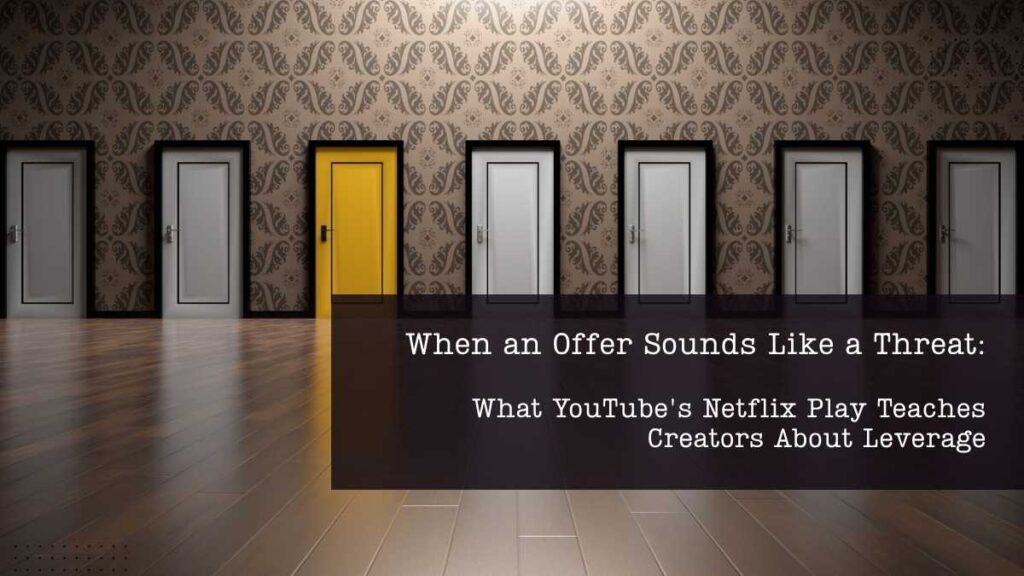
A lot of coverage has described this as a “carrot and stick.” I would put it more plainly. When the same party controls both the reward for compliance and the disadvantage for non-compliance, an offer and a threat start to look like the same thing wearing different clothes. “Here is a lot of money to be loyal” and “here is what loyalty protects you from” are not two separate facts. They are one arrangement.
That is not a criticism of YouTube. It is just how leverage works when one company is both your biggest distribution channel and the entity writing you a check. And it is exactly why creators need to understand the difference between the kinds of consequences a platform can attach to a decision like this.
Why the “consequences” are mostly discretionary, and why that matters
Here is the piece that most people will skim past, and the piece I most want creators to sit with.
Look at what YouTube reportedly said the consequences would be. Not featured in marketing. Not invited to events. Excluded from a share of certain brand deals.
Every one of those is discretionary. They are things YouTube already gets to decide, in the ordinary course, for almost any reason or no stated reason at all. YouTube is not, in these reports, promising to suspend anyone’s account, strip anyone’s existing revenue, or breach a signed contract. It is describing a world in which it simply chooses, going forward, to extend its discretionary goodwill to the creators who played along and withhold it from those who did not.
And discretionary consequences are, generally speaking, legal.
This is the distinction worth learning. There is a real legal difference between:
- Punishing you for a protected right, or breaching a promise it already made you (potentially actionable), and
- Declining to give you a benefit it was never obligated to give you in the first place (generally not actionable).
Choosing who to feature in a marketing campaign, who to invite to an event, or who to include in an optional brand program falls into that second bucket. Those are discretionary perks. A platform withholding a discretionary perk from a creator who went a different direction is, in most cases, just a platform exercising a choice it always had.
That is what makes this structure effective, and also what makes it hard to challenge. The pressure is real. But it is applied through the levers a platform is already allowed to pull.

The practical lesson for creators
None of this means “never take the deal.” Exclusive money can be great money, and for some creators this will be a genuinely good arrangement. The lesson is about knowing what you are actually weighing.
Understand what is contract and what is discretion. If YouTube pays you for exclusivity, that payment and its terms should live in a written agreement with defined obligations on both sides. But the “consequences” for non-exclusivity that are being floated here are mostly not contract terms at all. They are the informal, discretionary benefits you would be betting on keeping. Do not confuse the two. The money is a promise. The goodwill is a hope.
Price the thing you are actually giving up. Exclusivity has a cost. It closes the door on a second platform paycheck, a second audience, and the leverage that comes from not being dependent on one distributor. The Netflix arrangements creators have been signing are mostly non-exclusive precisely because “keep your existing business and add a new one” is a strong position. Before you trade that away, put a real number on it.
Read the exclusivity terms like they matter, because they do. For how long? Covering what content, exactly? What counts as a competing platform? What happens when the exclusivity period ends? “For a certain period of time” is doing a lot of quiet work in this story, and the specifics are where a deal is won or lost.
Get the discretionary promises in writing if they are part of your yes. If part of what is convincing you to sign is the marketing support and the brand-deal access, then ask for those to be committed, not assumed. If they will not commit to them, that tells you something important: they want the upside of your loyalty without owing you the benefit you thought you were getting for it.
The bigger picture
The reason this story matters beyond the handful of mega-creators in the room is that it is a preview of how platform leverage is going to be exercised as streamers and social platforms fight over the same talent. Not through dramatic bans. Through the quiet, lawful, discretionary machinery that platforms already control, repackaged as an offer you would be foolish to refuse.
The creators who navigate that well will be the ones who can tell the difference between a binding promise and a discretionary favor, and who negotiate accordingly. The ones who struggle will be the ones who heard “offer” and never noticed the sentence right after it.
An offer you cannot safely refuse is still worth reading closely. Maybe especially then.